

What if the greatest threat to your Patek Philippe or Rolex isn't the daily wear on your wrist, but the very place you leave it at night? Many collectors believe that simply placing a timepiece inside a drawer or a standard wooden box is enough to safeguard its finish. However, learning how to prevent watch scratches in storage is a fundamental skill that separates the amateur from the connoisseur. You've likely felt that sinking feeling when discovering a fresh "swirl mark" on a polished lug, despite the watch sitting idle for weeks. These microscopic abrasions often stem from dust particles or poor-quality linings that act like sandpaper over time.
A pristine, scratch-free collection requires more than just a soft surface; it demands total immobilisation and material purity. We understand the emotional and financial value of your timepieces, which is why this guide explores the professional techniques and premium storage solutions needed to eliminate friction and metal-on-metal contact. You'll discover how to select non-abrasive materials like high-grade velvet and suede, whilst ensuring your watches remain securely positioned. We will preview the essential role of carbon fibre winders, luxury watch rolls, and secure cushion systems in maintaining an organised and elegant display that protects your investment for years to come.
Key Takeaways
- Identify why environmental dust acts as a silent abrasive and how to shield your collection from microscopic "swirl marks" that compromise polished surfaces.
- Understand the "Mohs Scale" of storage and why your lining must always be softer than the metal it protects to ensure long-term preservation.
- Discover how to prevent watch scratches in storage by prioritising total immobilisation through high-tension cushions and secure fitment.
- Create dedicated buffer zones within your display to eliminate the risk of metal-on-metal contact between bracelets and cases during retrieval.
- Transition to a museum-grade environment that balances refined aesthetics with the structural protection of carbon fibre and luxury leather.
The Hidden Risks of Improper Luxury Watch Storage
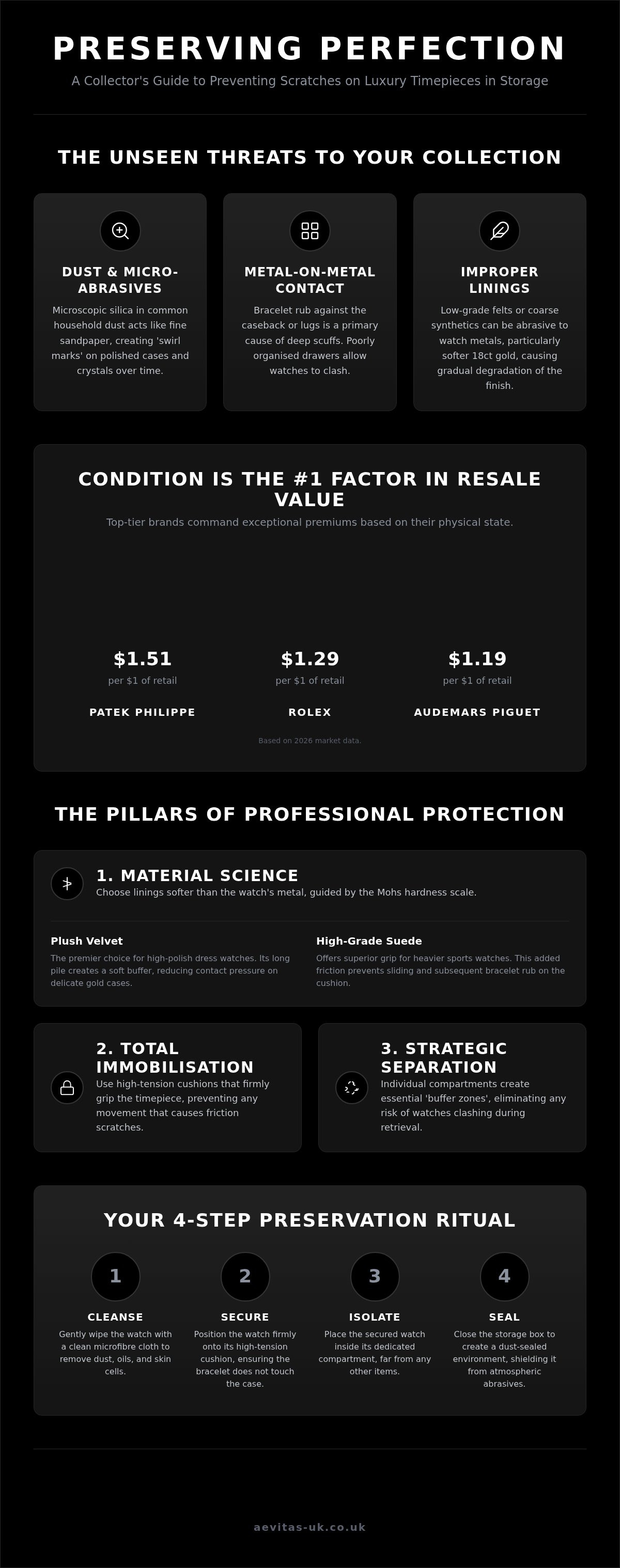
Many collectors assume that placing a timepiece inside a drawer or cabinet provides sufficient protection. This is a costly misconception. Storing a high-end watch is an extension of the science of timekeeping; it requires a deep understanding of material vulnerability and environmental control. Micro-scratches, often referred to as "swirl marks", are the most common form of degradation for polished steel and gold. These minute abrasions don't appear overnight. They develop through repeated, subtle friction against unsuitable surfaces. For precious metals like 18ct gold, which is significantly softer than stainless steel, the risk is even higher.
Condition is the single most influential factor in resale performance. According to 2026 market data, top-tier brands command exceptional premiums based on their physical state. Patek Philippe timepieces currently average $1.51 for every $1 of retail value, whilst Rolex and Audemars Piguet see $1.29 and $1.19 respectively. Maintaining "unpolished" status is vital to reaching these figures. Learning how to prevent watch scratches in storage involves moving beyond basic factory packaging. Whilst the original manufacturer box is excellent for provenance, some use foam inserts that degrade or trap moisture over time. Aevitas Watch Storage provides purpose-built solutions that prioritise material purity and long-term structural safety.
Dust and Atmospheric Abrasion
Dust is a silent abrasive. It often contains microscopic silica and other hard particles that settle on a watch's surface. When you pick up a dusty watch or wipe it with a dry cloth, those particles act like sandpaper, creating fine scratches on the crystal and case. An airtight or dust-sealed Aevitas Watch Storage box is essential for preservation. Always ensure a watch is cleaned with a soft microfibre cloth to remove oils and skin cells before it's placed into storage, as these attract more dust and can lead to tarnishing on certain alloys.
The Danger of Metal-on-Metal Contact
Bracelet rub is a primary cause of damage in poorly designed storage environments. When a watch is stored flat or on a loose cushion, the steel links of the bracelet can press against the case back or the side of the lugs. This constant metal-on-metal contact leads to deep scuffs that are difficult to remove without over-polishing. Multi-watch drawers without proper dividers are equally hazardous. Without a secure "buffer zone", watches can clash during the simple act of opening a drawer. Using a premium Aevitas Watch Storage box with individual, high-tension cushions ensures each piece remains perfectly immobilised and separated from its neighbours.
Material Science: Choosing Non-Abrasive Linings
Mastering how to prevent watch scratches in storage begins with a fundamental understanding of the Mohs Scale of mineral hardness. In horology, the objective is straightforward: the storage surface must be lower on the scale than the material it supports. Whilst 316L stainless steel has a hardness of roughly 5.5, 18ct gold is significantly softer, making it highly susceptible to abrasions from coarse synthetics or low-grade felt. Premium storage isn't just about padding; it's about material purity. Synthetic fabrics can sometimes off-gas chemicals or trap moisture, leading to oxidation or strap degradation over time. Choosing acid-free, high-quality linings ensures your collection remains in showroom condition.
Velvet vs. Suede: Which is Safer?
Material selection depends on the specific timepiece. Plush velvet is the premier choice for high-polish dress watches. Its long pile creates a soft buffer that reduces contact pressure on delicate gold cases. Conversely, suede offers superior grip and durability for heavier sports or diver watches. This additional friction prevents the watch from sliding on its cushion, which is a common cause of bracelet rub. For those managing a diverse collection, an Aevitas Watch Storage genuine leather watch box provides the ideal balance of luxury and protection. Always verify that materials are "acid-free" to prevent long-term tarnishing of precious metal components.
The Role of Carbon Fibre in Protection
Protection extends beyond the interior lining. The exterior shell must act as a rigid shield against external impacts. An Aevitas Watch Storage carbon fibre watch winder offers more than modern aesthetic appeal. This composite material is prized for its high strength-to-weight ratio and structural integrity. Unlike wood, which can warp or crack under environmental stress, carbon fibre remains stable and non-reactive. It provides a crush-resistant environment that protects the delicate internal movement from shocks whilst the watch is immobilised. It's a sophisticated solution for the collector who values both technical performance and aesthetics.
Investing in high-grade materials is the only way to ensure your timepieces survive the passage of time without cosmetic wear. If you're looking to upgrade your setup, explore our range of luxury watch boxes designed with museum-grade archival standards. This methodical approach to how to prevent watch scratches in storage guarantees that your investment remains as flawless as the day it was acquired.
Immobilisation: The Key to Preventing Friction Scratches
A correctly sized cushion is essential for long-term safety. If the pillow is too small, the watch will rotate or slide, potentially hitting the box lid or side walls. If it is too large, it risks over-stretching leather straps or placing too much pressure on clasp mechanisms. Aevitas Watch Storage cushions are designed to accommodate various wrist diameters, ensuring a snug fit for every piece in your collection. The soft-touch edges are equally vital. They ensure that even if the watch shifts slightly during handling, the contact points remain non-abrasive. This technical focus on fitment is what separates professional storage from generic alternatives.
Winders as Immobilisation Tools
Whilst some collectors view winders solely as mechanical maintenance tools, they are also superior immobilisation devices. A multi-watch winder provides individual, secure compartments that keep timepieces entirely separate. In Aevitas Watch Storage designs, the precision of the rotation cup ensures the watch remains locked in a specific orientation during motion. This eliminates the risk of "clashing" often found in loose storage drawers. By keeping the watch secure whilst in motion, you combine mechanical health with physical surface protection. It's a sophisticated method for how to prevent watch scratches in storage, offering peace of mind for high-value collections that require constant readiness.
Strategic Organisation for Multi-Watch Collections
Technical spacing is a critical consideration for modern collections. Standard boxes often fail to accommodate oversized 44mm+ watch heads, leading to watches touching at the edges. You require at least 1.5 to 2 centimetres of clearance between each cushion to ensure safety. Deep-well designs are equally important for watches with thick sapphire crystals or prominent bezels. High-clearance lids are a necessity; they prevent "crystal-strike" where the glass makes contact with the lid when closed. Aevitas Watch Storage selects boxes that respect these physical dimensions to ensure your crystal and bezel remain untouched.
Scratch Prevention During Travel
Travel represents the highest risk environment for cosmetic damage. Whilst many use simple pouches, leather watch rolls are vastly superior for how to prevent watch scratches in storage whilst on the move. A quality roll ensures a "floating" watch head, where the case is suspended on a cushion and never touches the roll’s outer wall. This structural isolation is vital for absorbing external shocks. Ensure the strap is tightly secured around the cushion to prevent the buckle or clasp from vibrating against the case back, which is a common cause of deep scuffs during transit.
To ensure your collection remains protected wherever you go, browse our range of Aevitas Watch Storage leather watch rolls featuring secure cushion systems and premium non-abrasive linings. This is the professional standard for the mobile collector who refuses to compromise on condition.
Premium Storage Solutions: The Aevitas Watch Storage Standard
Aevitas Watch Storage represents the pinnacle of protective horological engineering. Our design philosophy centres on the belief that a storage solution should be as meticulously crafted as the movement it houses. By integrating professional techniques into every product, we provide a definitive answer for how to prevent watch scratches in storage. It's about moving from simple boxes to archival-standard environments. We utilise materials that exceed museum requirements, ensuring your collection remains shielded from the environmental and mechanical risks discussed in earlier sections. This methodical approach transforms a simple storage container into a sophisticated tool for asset preservation.
Selecting the right product depends on your collection's scale and your specific handling habits. Whether you require a compact travel roll for a weekend away or a multi-unit safe for a lifetime of collecting, the standard remains identical. Aevitas Watch Storage prioritises the longevity of your timepieces through a deep understanding of material science and fitment. Our products are compatible with all luxury brands, from Rolex to Patek Philippe, ensuring that every piece receives the same level of specialised care. This is the final step in mastering how to prevent watch scratches in storage, allowing you to transition from disorder to a state of refined control and high-end elegance.
Bespoke Protection in Every Detail
The 12 Watch Box Carbon Fibre exemplifies our commitment to large-scale protection. Its rigid exterior provides superior structural integrity, whilst the internal velvet linings are specifically selected for high-frequency use. We use a combination of piano-black wood and carbon fibre to ensure durability against external impacts. These materials don't just look elegant; they serve as a functional barrier against the dust and friction that threaten polished surfaces. Each compartment is sized to provide the necessary buffer zones required for modern, oversized timepieces, ensuring no two watches ever make contact.
The Ultimate Secure Storage
For the most valuable collections, the integration of security and scratch prevention is paramount. A watch winder safe offers the ultimate sanctuary for your horological investment. These units combine the robust physical protection of insurance approved watch safes with the technical benefits of precision winding. Internal winder configurations keep each watch pristine and ready to wear, maintaining mechanical health whilst ensuring total immobilisation. This is where British engineering meets high-end luxury. You gain the peace of mind that comes from knowing your investment is safe from both theft and cosmetic degradation in a single, secure environment.
Elevate Your Collection’s Preservation Standards
The journey from a casual collection to a curated horological gallery requires a fundamental shift in how you perceive protection. You now possess the technical framework for how to prevent watch scratches in storage by prioritising material purity, total immobilisation, and strategic spacing. These professional standards ensure that the factory finish of your timepieces remains undisturbed by the silent threats of atmospheric dust and metal-on-metal friction. By moving beyond generic containers, you safeguard both the financial and emotional value of your investment for the next generation.
As the UK’s best-selling premium brand, Aevitas Watch Storage provides the precision engineering required to maintain these high standards. Our solutions are compatible with Rolex, Patek Philippe, and all luxury marques, ensuring museum-grade care for every item in your collection. With free insured delivery worldwide, the transition to refined order is seamless and secure. Explore the Aevitas Watch Storage Collection of Luxury Watch Boxes and Winders to secure your timepieces in an environment they deserve. Elevate your storage today and enjoy the peace of mind that comes with professional preservation.
Frequently Asked Questions
Can a watch box actually scratch my watch if the lining is too rough?
Yes, a poorly chosen lining is a primary cause of micro-abrasions. Synthetic felts or coarse fabrics often have a higher hardness rating than the polished steel or gold they're meant to protect. Professional collectors prioritise acid-free velvet or high-grade suede. These materials ensure that any contact remains non-abrasive. Investing in a premium watch presentation box is a critical step in mastering how to prevent watch scratches in storage over the long term.
Is it better to store a watch with the crown pulled out or pushed in?
You should always store your watch with the crown fully pushed in or screwed down. Leaving the crown pulled out exposes the movement to dust and moisture; this can lead to internal degradation. Whilst some believe this saves battery life in quartz models, the risk of atmospheric contamination far outweighs the benefit. A sealed case is your first line of defence against the environmental elements that cause tarnishing and movement failure.
How do I prevent the bracelet from scratching the case back in a watch box?
Total immobilisation on a high-tension cushion is the most effective solution. Bracelet rub occurs when the links are allowed to collapse against the case back during movement. By using a correctly sized watch pillow, you keep the bracelet expanded and away from the polished metal surfaces. This structural support is a cornerstone of how to prevent watch scratches in storage, especially for watches with heavy oyster or jubilee style bracelets.
Are watch rolls safer than watch boxes for long-term storage?
Both formats offer exceptional safety if they utilise museum-grade materials. Watch rolls are specifically engineered for portability; they use secure cushion systems to prevent the watch from shifting during transit. Watch boxes are generally preferred for stationary displays where visibility and organisation are the primary goals. For long-term preservation, the quality of the internal lining and the security of the fitment are more important than the external shape of the container.
Does dust really cause scratches on stainless steel watches?
Dust is a significant threat because it often contains microscopic silica particles. These particles are harder than stainless steel and precious metals. When dust settles on a watch and is wiped away with a dry finger or cloth, it creates fine "swirl marks" on the polished surfaces. Always use a clean microfibre cloth and store your timepieces in a dust-sealed environment, such as a carbon fibre watch winder or a presentation box.
What is the best material for a watch box lining to avoid scuffs?
Acid-free velvet and premium microsuede are the industry standards for scratch prevention. These materials are chosen for their soft pile, which creates a protective buffer around the watch case. Unlike low-quality synthetics, they don't off-gas chemicals that can tarnish metal or dry out leather straps. High-end storage solutions from Aevitas UK utilise these linings to ensure that even the most delicate high-polish finishes remain in showroom condition for years.
How can I store my watch safely if I do not have a dedicated box?
If a dedicated box isn't available, wrap the timepiece in a clean microfibre cloth and place it on a soft surface. Never leave a watch face-up on a hard table or inside a drawer where it can slide. This temporary measure provides a basic barrier against dust and accidental contact. However, for high-value items, you should transition to a professional watch stand or travel roll as soon as possible to ensure proper immobilisation.
Should I use a watch stand for daily storage to prevent scratches?
Yes, a watch stand is an excellent solution for daily storage. It keeps the watch head elevated and prevents the case and bracelet from making contact with hard surfaces like marble or wood. By suspending the watch, you eliminate the risk of surface scuffs that occur when a timepiece is repeatedly picked up and set down. It provides an elegant display whilst maintaining the "unpolished" status of your favourite daily wearer.