

Is your dormant timepiece actually a ticking time bomb for your bank balance? Many collectors believe that leaving a movement to rest is a form of preservation, but the reality is often the opposite. When you consider what happens if you don't wind an automatic watch, the primary concern isn't just a loss of time; it is the silent degradation of internal lubricants and the eventual loss of mechanical suppleness. With professional service costs for mainstream Swiss brands now reaching over £1,400, an idle watch represents a significant financial risk.
We understand the frustration of facing expensive overhauls or the tedious task of resetting complex perpetual calendars. You deserve a clear, professional strategy to protect your investment. In this guide, you will discover the precise mechanical impact of letting your timepieces sit and learn the industry standards for long-term luxury watch storage. We will provide a definitive routine to help you choose between a precision winder or a high-quality presentation box with absolute confidence.
Key Takeaways
- Understand precisely what happens if you don't wind an automatic watch, including the risk of lubricant coagulation and mechanical stagnation.
- Learn how to maintain gasket and seal integrity through regular movement to ensure your timepiece remains protected and water-resistant.
- Identify the mechanical "Danger Zone" to prevent internal damage when resetting complex perpetual calendars or moon phase complications.
- Establish a professional storage routine that prioritises environmental stability and meticulous cleaning to preserve the exterior finish.
- Determine whether a precision watch winder or a luxury presentation box is the superior choice for your specific horological assets.
The Immediate and Long-Term Effects of an Unwound Automatic Watch
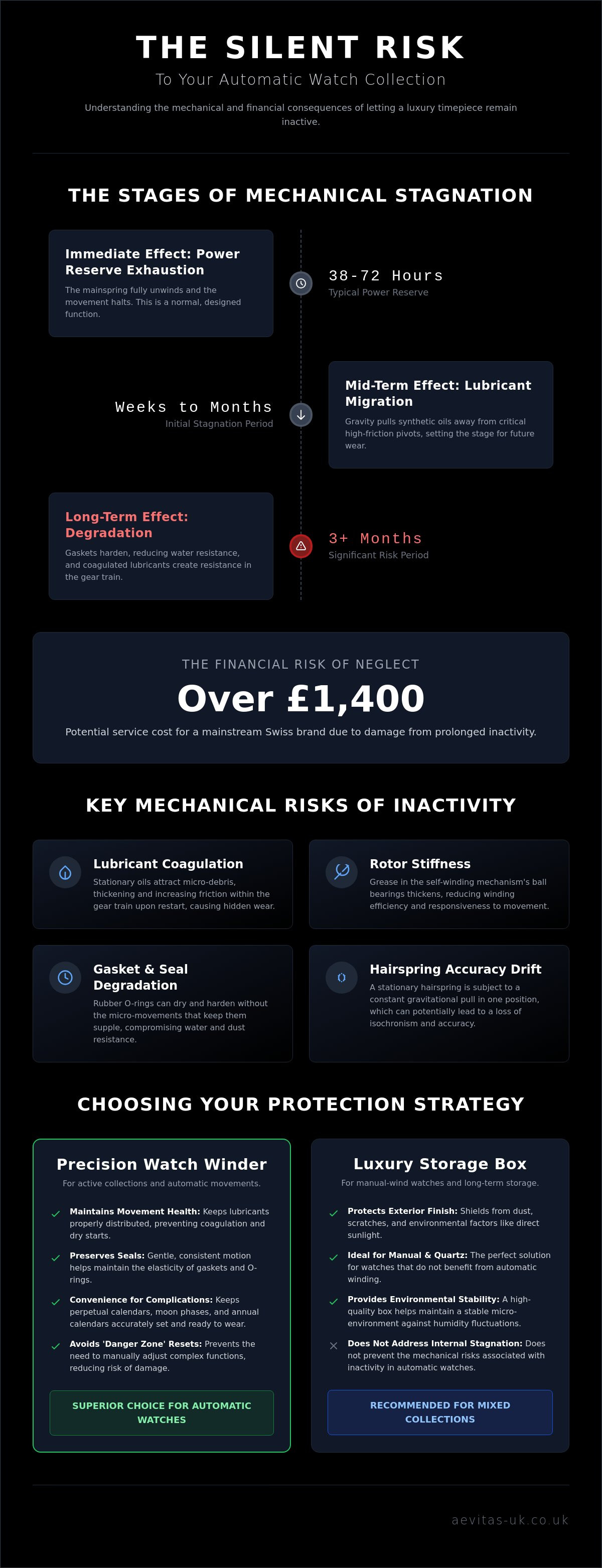
An Automatic watch relies on a delicate equilibrium of kinetic energy and mechanical tension. When you remove it from your wrist, a countdown begins. Most modern calibres possess a power reserve ranging from 38 to 72 hours. Once this window closes, the mainspring completely relaxes and the movement halts. This immediate stop is a design feature, not a failure. However, the real concern regarding what happens if you don't wind an automatic watch lies in prolonged inactivity. Mechanical stagnation is a silent threat to precision.
Many collectors mistakenly believe that letting a watch stop 'saves' the movement from wear and tear. This is a persistent myth. Mechanical movements are engineered to run. Just as a vehicle's engine seals can perish if left stationary, a watch movement requires regular motion to distribute internal fluids. A watch left for three days is merely resting. A watch left for three months is entering a state of mechanical stagnation that can lead to expensive service requirements.
Just as you might explore Wheels For Rolls Royce to ensure your luxury vehicle maintains its performance and prestige, your timepieces require similar attention to mechanical detail to avoid long-term damage.
Power Reserve vs. Permanent Stoppage
The mainspring is the heart of your watch's energy storage. As it unwinds, it loses the torque necessary to drive the gear train. In a 'dormant' state, the watch simply lacks energy. In a 'dead' state, which occurs after months of neglect, the components may require more than a simple shake to restart. Understanding what happens if you don't wind an automatic watch over several months is essential for any serious collector. Reanimating a long-dormant movement requires a gentle, manual wind of the crown to safely reintroduce tension without straining the escapement.
The Role of Modern Lubricants
Vintage timepieces used animal-based oils that would eventually turn into a gummy paste. Modern luxury watches utilise advanced synthetic lubricants designed for stability. These do not dry out in the traditional sense, but they are subject to migration. When a watch remains stationary, gravity causes these oils to pull away from the high-friction pivots they are meant to protect. Whilst modern oils don't 'dry out' like old ones, they still settle over time. This settling creates a dry start when you finally decide to wear the piece again, potentially causing micro-abrasions on the jewels and pivots. Consistent movement ensures these oils remain exactly where the master watchmaker intended.
- Immediate Effect: Power reserve exhaustion within 2-3 days.
- Mid-Term Effect: Lubricant migration away from critical friction points.
- Long-Term Effect: Potential for gasket hardening and mechanical resistance.
The Mechanical Risks of Prolonged Inactivity
The mechanical risks of leaving a luxury timepiece idle extend far beyond a simple loss of time. Whilst the power reserve exhaustion discussed previously is immediate, the secondary effects of stagnation are cumulative. One of the most significant concerns involves the internal lubricants. When these oils pool in stationary pivots, they can attract microscopic debris, creating a 'coagulation' effect. This increases resistance within the gear train, forcing the movement to work harder once it is finally restarted. Understanding what happens if you don't wind an automatic watch is the first step in preventing this hidden mechanical wear.
Rotor stiffness is another common byproduct of neglect. The ball bearings within the self-winding rotor require regular rotation to distribute their own specialised grease. Without this motion, the grease can thicken, leading to a loss of winding efficiency. You might find that a watch which previously reached full power with a day's wear now struggles to maintain its reserve. To prevent this mechanical sluggishness, many collectors utilise multi watch winders from the UK's best-selling premium brand to ensure every piece in their rotation remains in peak condition. This proactive approach maintains the rotor's responsiveness and protects the delicate ball-bearing race from premature wear.
- Loss of gasket elasticity: Reduced protection against environmental moisture.
- Increased friction: Coagulated lubricants create resistance in the gear train.
- Reduced winding efficiency: Thickened rotor grease hampers self-winding performance.
- Hairspring deformation: Potential for accuracy drift due to constant gravitational pull on a stationary spring.
Seal Preservation and Water Resistance
Rubber O-rings and gaskets are the silent guardians of your watch's internal environment. These components require a degree of physical 'exercise' to remain supple. When a watch sits for years, gaskets can become brittle or develop flat spots under constant pressure. This compromise in seal integrity often goes unnoticed until the watch is exposed to water. A running watch generates a negligible but consistent amount of internal heat. Conversely, a stone-cold, stationary watch is more susceptible to moisture intrusion from environmental humidity, which can lead to the oxidation of steel components or the fogging of the sapphire crystal.
Accuracy and Timekeeping Drift
Prolonged inactivity can fundamentally alter a watch's rate. The hairspring, a delicate coil thinner than a human hair, can develop a 'memory' if left in a single position for too long. Gravity acts upon the stationary spring, potentially causing it to sag or lose its perfect concentricity. When the watch is eventually wound, you may notice a significant drift in accuracy that was not present before. In some cases, the regulation becomes so erratic that only a professional overhaul can restore the movement. Recognising what happens if you don't wind an automatic watch for years helps collectors avoid these avoidable service costs and maintain the precision of their movements.
The Complication Headache: Why Winding Matters for Complex Watches
For the discerning collector, the inconvenience of a stopped watch scales with its complexity. Simple three-hand models are easily corrected, but high-complication timepieces present a different challenge entirely. Perpetual calendars, moon phases, and annual calendars are mechanical marvels designed to run continuously. When these movements halt, the owner is faced with a tedious and often delicate synchronisation process. Understanding what happens if you don't wind an automatic watch with these features is essential for avoiding both frustration and potential mechanical failure.
The primary concern for complex calibres is the 'Danger Zone'. This period, typically between 9 PM and 3 AM, is when the date-change gears are physically engaged with the timekeeping train. Attempting to adjust the date or complication during these hours can shear the teeth off delicate wheels or bend fragile levers. If a watch stops within this window, the risk of accidental damage during a manual reset increases significantly. Keeping the movement active ensures the gears transition naturally, bypassing the need for risky manual intervention.
The Risk of Manual Adjustments
Many luxury complications rely on pusher-based systems or specific crown sequences to advance the calendar. These components are notoriously fragile. Repeated manual adjustments to a stopped watch increase the wear on these small pushers and the internal springs that return them to position. A winder eliminates this repetitive stress. By maintaining a constant state of readiness, you protect the mechanical interlocking of the date and time functions, ensuring the movement remains in perfect harmony without the need for constant correction.
Preserving the Perpetual Calendar
Perpetual calendars are engineered to track leap years and centuries without human assistance. If one of these masterpieces remains idle for several months, the sheer volume of data to be reset can be overwhelming. Certain grand complications are so intricate that if they stop for an extended period, they require a trip back to the manufacturer for professional synchronisation. This is not only time-consuming but can be remarkably expensive.
A multi watch winder is the essential tool for high-complication collectors. It acts as a preventive maintenance device, keeping the perpetual cycle moving and ensuring your most valuable assets are always ready for the wrist. This proactive approach respects the engineering of the movement and safeguards the long-term value of your collection. What happens if you don't wind an automatic watch of this calibre is a loss of both convenience and mechanical security, making active storage a necessity rather than a luxury.
How to Store Luxury Watches Long Term: A Step-by-Step Guide
Preserving a luxury collection requires more than just a secure drawer. It demands a methodical approach to environmental control and physical maintenance. Understanding what happens if you don't wind an automatic watch allows you to mitigate risks through a structured storage protocol. Follow these steps to ensure your timepieces remain in showroom condition during periods of inactivity.
- Step 1: Meticulous Cleaning. Skin oils, perspiration, and environmental salts are naturally corrosive. Use a high-quality microfibre cloth to wipe down the case, bracelet, and crystal. This prevents the pitting of stainless steel and the degradation of precious metal finishes.
- Step 2: Environmental Control. Humidity is the enemy of mechanical movements. Store your watches in a cool, dry place away from direct sunlight. UV rays can fade dials and age luminous material prematurely.
- Step 3: Strategic Orientation. If not using a winder, store the watch dial-up. This position provides the most stable orientation for the balance wheel to rest.
- Step 4: Security Integration. High-value assets require physical protection. Integrating your collection into a watch winder safe provides total peace of mind by combining mechanical maintenance with insurance-grade security.
- Step 5: Periodic Maintenance. For watches kept in static boxes, implement a monthly wind routine. Knowing what happens if you don't wind an automatic watch helps you appreciate why this cycle is necessary to redistribute lubricants and keep the movement supple.
Preparing the Watch for Storage
Before a watch enters long-term rest, a thorough inspection is vital. Check for any existing damage or signs of moisture ingress. Ensure the crown is fully depressed or screwed down; an open crown is an open invitation for dust and humidity to enter the movement. This simple check is the difference between a successful rest and an expensive repair bill. Use a clean cloth to remove all corrosive elements from the case back and between the lugs where salt deposits often hide.
Beyond physical cleaning, ensuring the surrounding climate is controlled is paramount. Experts like First Choice Plus Plumbing & Air advise that stable indoor conditions are essential for protecting all delicate machinery, whether it is a home's infrastructure or a fine horological movement.
While internal climate control is vital, maintaining the exterior of your property is just as important for overall security; you can discover Revira to explore ethical ways to protect your garden from pests like mice and badgers.
Environmental and Security Standards
Consistency is the hallmark of professional storage. Aim for a temperature range of 15 to 25 degrees Celsius. Extreme fluctuations cause metals to expand and contract, which can stress the gaskets. If you live in a humid climate, include silica gel packets in your storage box to absorb excess moisture. For those seeking the ultimate solution, explore our premium watch storage solutions to find a system that meets these exacting standards whilst providing the protection your collection deserves.
Professional Solutions: Choosing Between a Winder and a Storage Box
Selecting the appropriate storage medium is a strategic decision for any serious collector. The choice between active rotation and passive rest depends entirely on the composition of your horological portfolio. While previous sections detailed what happens if you don't wind an automatic watch, the solution lies in matching the storage environment to the movement's specific requirements. Modern automatics with complex calendars demand a different approach than vintage, manual-wind heirlooms.
Watch winders serve as the premier solution for daily wearers and high-complication pieces. These devices maintain the power reserve by mimicking the natural motion of the wrist. Aevitas UK designs these units with programmable Turns Per Day (TPD) settings to ensure compatibility with all major luxury brands. For instance, most modern Rolex calibres require 650 to 800 TPD bi-directionally to maintain peak performance. Using a winder prevents the mechanical stagnation and lubricant migration that occur during prolonged inactivity.
Conversely, a luxury watch presentation box is the superior choice for manual-wind pieces or vintage watches with delicate winding systems. These timepieces do not benefit from constant rotation; instead, they require a secure, dust-free environment where they can remain stationary. This prevents unnecessary wear on aging components whilst keeping the collection organised and protected from environmental factors. For collectors who need to transport these boxes or move their entire collection, sourcing high-quality packaging from Phoenix Supplies UK ensures that the outer housing of your collection is as protected as the movements themselves.
When to Invest in a Watch Winder
The decision to invest in a winder usually follows two criteria: the size of your rotation and the complexity of your complications. If you frequently alternate between three or more watches, a winder provides the luxury of 'grab and go' convenience. You eliminate the need to reset the time and date every morning, which reduces wear on the crown and winding stem. For those seeking high-performance materials and modern aesthetics, our Ultimate Guide to Carbon Fibre Watch Winders offers a deep dive into the technical benefits of these advanced storage solutions.
Balancing Protection and Display
Your storage strategy should be as varied as your collection. While a multi watch winder handles your daily rotation, a luxury watch roll travel case is the essential companion for short-term transit. These rolls provide the same level of internal protection and material quality as a stationary box but in a portable format. For those who require the same level of security for their gear while travelling, you can explore 21" Classic Carry-On options that utilise high-grade aluminium. Ultimately, understanding what happens if you don't wind an automatic watch allows you to tailor your routine. By combining the security of a winder safe with the elegance of a presentation box, you ensure each timepiece is preserved according to its unique mechanical needs.
- Watch Winders: Best for modern automatics, perpetual calendars, and daily rotations.
- Presentation Boxes: Ideal for manual-wind watches, vintage pieces, and long-term dormant storage.
- Travel Cases: Essential for maintaining protection and order whilst away from home.
- Winder Safes: The ultimate solution for high-value collections requiring both maintenance and security.
The Path to Lasting Mechanical Excellence
Preserving a luxury timepiece is a commitment to engineering heritage. By understanding what happens if you don't wind an automatic watch, you have moved beyond the myth of resting a movement and into the realm of professional preservation. Active management prevents lubricant migration and protects complex complications from the inherent dangers of manual resetting. Whether you choose the constant rotation of a winder or the stable environment of a presentation box, your priority remains the same: the prevention of mechanical stagnation.
This dedication to precision and mechanical reliability is a hallmark of quality engineering, whether in horology or in industrial applications where companies like Choice Bagging Equipment set the standard for high-performance machinery.
Aevitas UK stands as the UK's best-selling premium watch winder brand, offering solutions crafted from high-performance carbon fibre and solid wood. Our products provide the precision and protection your collection demands, ensuring every piece is ready for the wrist at a moment's notice. Take the next step in refining your storage routine and enjoy free insured worldwide delivery on all orders. Explore the Aevitas UK Collection of Premium Watch Winders today and secure the longevity of your investment. Your timepieces deserve nothing less than professional-grade care.
Frequently Asked Questions
Is it bad to let an automatic watch stop for a long time?
Prolonged inactivity can lead to mechanical stagnation and a loss of precision. When you consider what happens if you don't wind an automatic watch over several months, the primary risks involve lubricant migration and the hardening of rubber gaskets. These issues increase internal friction and can compromise the watch's water resistance. Regular motion keeps the movement supple and ensures the timepiece is ready for immediate use without the risk of a dry start.
How often should I wind my automatic watch if I'm not wearing it?
You should aim to wind your watch at least once every thirty days. This periodic cycle is sufficient to redistribute synthetic lubricants across critical pivots and jewels within the movement. A manual wind of twenty to thirty turns of the crown is usually enough for most calibres. For those with larger collections, using a multi watch winder for a few hours each month provides a consistent and efficient method of maintaining mechanical health.
Can a watch winder damage my automatic watch by over-winding it?
Modern luxury movements feature a built-in safety mechanism called a slipping spring that prevents over-winding. Once the mainspring reaches full tension, the bridle simply slides along the inside of the barrel to release excess energy. Premium winders further protect the movement by utilising intermittent rotation cycles. These rest periods ensure the watch isn't under constant tension, mimicking the natural behaviour of daily wear whilst maintaining the power reserve safely.
What is the best way to store a luxury watch for several months?
Professional storage requires a three-tier approach: cleanliness, environmental control, and security. First, remove skin oils and salts with a microfibre cloth to prevent corrosion. Store the piece in a dedicated watch winder safe to maintain the movement whilst providing insurance-grade protection. If using a static box, ensure the environment is temperate and utilise silica gel packets to manage humidity. This prevents gasket degradation and protects the dial from moisture-related oxidation.
Do I need to service my watch if it hasn't been used for a year?
A one-year hiatus doesn't always mandate a full overhaul, but a professional inspection is highly recommended. Even if the watch runs, the lubricants may have settled or migrated away from high-friction zones during its time in storage. Have a specialist like Atoz Watch And Jewellery Repairs perform a pressure test to verify seal integrity and a timing analysis to check for rate drift. This proactive maintenance is far more cost-effective than repairing a movement damaged by a dry start after a long period of neglect.
This principle of expert diagnostic oversight is equally important for other high-value technology in your life; for instance, EVdiagnostika.si provides licensed, independent battery testing for electric and hybrid vehicles to ensure their continued efficiency and safety.
Does the position of the watch during storage affect its accuracy?
Gravity exerts a constant influence on the hairspring and balance wheel, and this effect varies depending on the watch's orientation. Storing a watch dial-up is the standard position for stability, but it can lead to slight accuracy deviations over time. A watch winder mitigates this by rotating the piece through various angles, effectively cancelling out positional errors. This dynamic storage method ensures the movement remains regulated and provides a more accurate timekeeping experience when you return it to your wrist.
Should I keep my automatic watch on a winder 24/7?
It is perfectly safe to keep a watch on a winder continuously, provided the device uses appropriate rest cycles. High-quality units are designed with specific Turns Per Day (TPD) settings and directional controls to prevent unnecessary mechanical wear. This constant state of readiness ensures that what happens if you don't wind an automatic watch, such as the exhaustion of a perpetual calendar's data or moon phase settings, never becomes a frustration for the collector.
Can I wind an automatic watch manually too often?
While possible, frequent manual winding can put excessive stress on the winding pinion and the delicate seals within the crown tube. Automatic movements are primarily engineered to be wound by the rotor's motion. It is best to use the crown only to jump-start the movement after it has completely stopped. For consistent power, rely on a winder or regular wrist time to protect these smaller, more vulnerable internal components from premature wear and tear.
0 comments