

The most valuable watch on your wrist may not be the right one to take on your trip. The safest plan depends on your itinerary, how you’ll travel and whether you’re prepared to keep the watch close throughout the journey. Knowing how to travel with expensive watches safely starts before you choose a case.
It’s natural to worry about knocks, loss or theft, and to wonder whether to wear your watch, pack it or leave it at home. A travel case can help keep a watch organised in transit, but it can’t replace careful handling or a plan for the rest of your collection.
This guide helps you weigh up what to take and how to carry it, including practical considerations for a luxury watch roll travel case. You’ll also learn what to document, what to check with your insurer and travel provider, and how to think ahead about secure storage at home or away. The aim is a considered plan that suits your watch and your journey, without leaving important details to chance.
Key Takeaways
- Learn how to travel with expensive watches safely by matching your choice of watch and carrying method to your itinerary.
- Use a simple pre-travel routine to check your watch, record key details and follow the manufacturer’s guidance.
- Compare wearing a watch, carrying it in a travel roll or leaving it securely stored at home before deciding what suits your plans.
- Check your chosen travel case for fit, capacity and verified construction, then confirm relevant conditions with your insurer and travel provider.
How to travel with expensive watches safely starts with a risk-aware plan
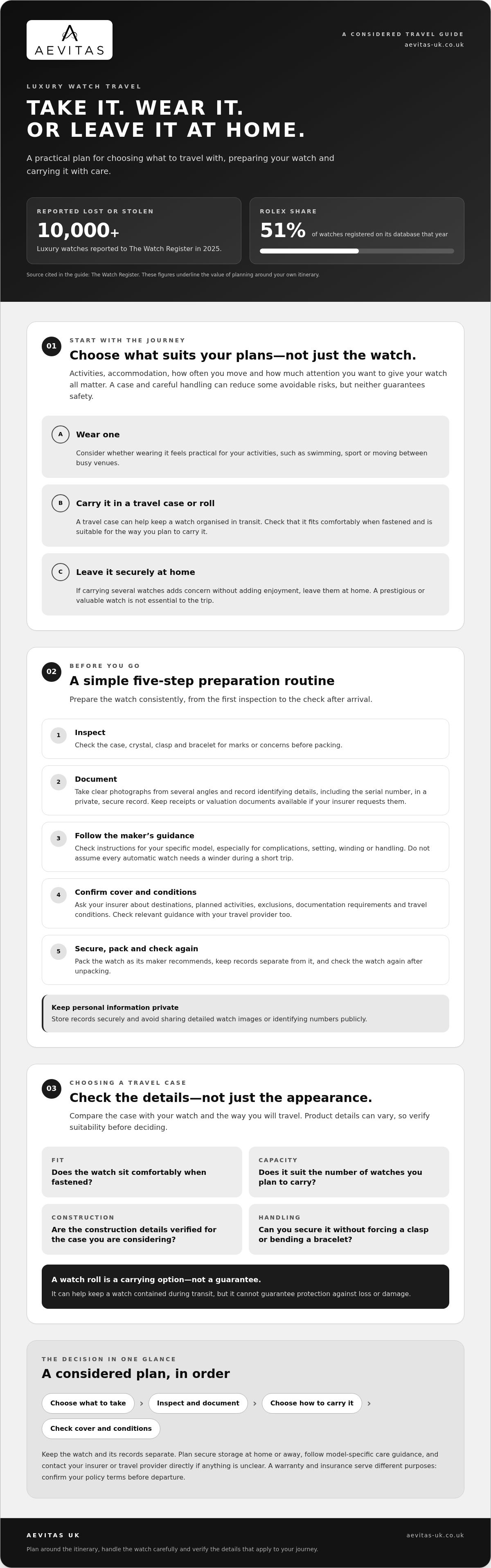
A watch can be part of the pleasure of a trip, whether it’s a trusted daily wearer or a piece with personal significance. But enjoying it away from home means weighing that pleasure against the possibility of loss or damage. The Watch Register reported that more than 10,000 luxury watches were reported lost or stolen in 2025, with Rolex accounting for 51% of watches registered on its database that year. Those figures underline why a sensible travel plan should start with your own itinerary, not simply the prestige of the watch.
Activities, accommodation, the number of watches you plan to take and how often you’ll move between locations all shape the decision. Start with a straightforward sequence: choose which watch, if any, to take; inspect it; record identifying details; decide how you’ll carry it; and confirm relevant insurance cover. A case and careful handling can reduce some avoidable risks, but neither guarantees safety.
Should you take an expensive watch on your trip?
What should you check before travelling with a watch?
Inspect the watch, photograph it clearly and record identifying details, including its serial number, in a private record. Follow the manufacturer’s care guidance for that specific watch, particularly if it has complications or handling requirements.
Contact your insurer to check cover for your destinations and planned activities, along with any exclusions, documentation requirements or travel conditions. A warranty and insurance serve different purposes, so confirm the policy terms directly before departure.
Prepare an expensive watch for travel without risking avoidable damage
A little preparation makes it easier to handle a watch consistently from packing to arrival. Use a simple sequence: inspect, document, secure, pack and check again when you reach your destination. The details matter. A bracelet, clasp or complication may need specific handling, so follow the manufacturer’s guidance for your watch rather than relying on assumptions about its brand or type.
Inspect and document the watch before departure
Pack and handle the watch with care
Secure the watch as its maker recommends. Don’t force a clasp or bend a bracelet to make it fit a cushion. Choose a travel case by checking its construction and whether the watch fits comfortably when fastened, not by appearance alone. Product details can vary, so confirm them before deciding whether a particular case suits your watch.
A watch roll is one carrying option for keeping a watch contained during transit, but it can’t guarantee protection against loss or damage. If that format suits your needs, compare the leather watch roll travel cases with your watch’s dimensions and the way you plan to carry it.
Check any model-specific care requirements
Setting, winding and handling guidance differs between watches. Consult the manufacturer’s instructions for your specific model, especially if it has a complication or a particular winding procedure. Don’t assume every automatic watch needs to be kept on a winder during a short trip; check the maker’s advice and your own requirements before adding equipment to your packing list.
Keep the watch and its records separate, and check the watch again after unpacking. If you’re travelling within the UK, check any relevant travel-provider guidance for your journey and confirm with your insurer that you understand the conditions applying to your watch while travelling. Contact those providers directly if anything is unclear.
Watch roll, wrist or home storage: compare the travel options
The right choice depends on how you’ll spend your time away and how much responsibility you want to carry. Wearing a watch keeps it with you but may not suit every activity. A travel roll can hold a watch separately when that’s more convenient. Leaving the collection at home removes it from the journey altogether. This comparison can help you decide how to travel with expensive watches safely without assuming one option suits every trip.
| Option | Convenience | Number of watches | Best suited to | What to verify |
|---|---|---|---|---|
| Wear one watch | Ready to wear, with no separate case to carry. | One | Plans where wearing a watch is comfortable and appropriate. | Whether activities and the watch’s care guidance make wearing it practical. |
| Carry a watch in a roll | Keeps the watch separate from your wrist when you’re not wearing it. | Match the case capacity to the watches you genuinely need. | Itineraries where you want the option to take a watch off or change what you wear. | Fit, dimensions, materials and construction on the product page. |
| Leave watches at home | Simplifies packing and removes those watches from the journey. | Any number not needed on the trip. | Trips where wearing or carrying a valuable watch would add concern. | That watches left behind have suitable storage at home. |
A watch roll is a carrying option, not a guarantee of security or insurance cover. Neither the product type nor its appearance establishes how a policy treats a watch, or how secure it will be in a particular situation. Check the product details and ask your insurer about the cover and conditions that apply.
When is a watch roll a practical choice?
Consider a roll if you’d rather carry a watch separately from your wrist, such as when changing for an evening or choosing not to wear it during an activity. Match capacity to the number you’ll actually take, rather than packing additional watches “just in case”. A single-watch leather travel roll is one option to compare; check its listed dimensions, materials and construction against your watch before choosing.
When might wearing one watch or leaving it at home make sense?
Wearing one watch may suit a straightforward itinerary if it feels comfortable and aligns with the watchmaker’s care advice. For active plans or a trip where the watch would cause more worry than enjoyment, leaving it behind can be the simpler decision. Store watches not taken in appropriate home storage, such as a watch box for home storage, and consider your home’s security separately.
Protect your watch through airports, journeys and overnight stays
Good handling is a series of small, deliberate decisions. Keep the watch within your awareness, avoid unnecessary handling in busy or distracting places, and check current instructions from your airline or other travel provider before setting off. No single packing method is theft-proof or accepted in every situation, so confirm what applies to your journey.
Departure and transit
Before leaving, decide where the watch will stay during each part of the journey and keep that arrangement consistent. If you remove it for a security check or another procedure, place it somewhere secure and readily accessible rather than leaving it loose or unattended. Follow staff instructions and your carrier’s current guidance, particularly if your luggage or travel arrangements change.
Keep a record of the relevant airline or travel-provider guidance you’ve checked, and ask the insurer whether the policy has conditions for watches in transit, including how they must be carried. Don’t assume that a watch in a case, or in a particular type of bag, automatically meets those conditions.
Overnight stays
On arrival, choose a consistent place for the watch when you take it off. Before relying on storage provided by your accommodation, ask staff what arrangements are available and how they operate. Then compare that information with your insurer’s specific requirements. A room safe, reception storage or another facility should not be assumed to provide cover or a particular level of security without confirmation from the relevant providers.
For watches left at home, travel planning can also prompt a review of your usual storage. Aevitas Watch Storage offers watch winder safes as a storage option; check the product details and any relevant insurance conditions against your own requirements.
Return journey and unexpected problems
Before checking out, make a deliberate final check of the place where you kept the watch. Keep it close and accounted for through each transfer, and follow the latest carrier instructions for the return journey. If you’re travelling across borders, check any relevant requirements with the appropriate authority rather than relying on general advice.
If the watch is lost, stolen or damaged, contact your insurer and travel provider promptly and follow their stated reporting processes. Your pre-trip photographs, identifying details and ownership records can help support an enquiry or report. Keep copies accessible without storing them alongside the watch, and note who you contacted and when. Reporting promptly helps you provide clear information, but recovery, reimbursement and claims decisions depend on the circumstances and the relevant provider’s terms.
Choose a travel watch case that suits your collection and journey
A travel case should fit the watch you’re actually taking and the way you’ll carry it. Capacity alone isn’t enough: check dimensions, materials and construction in the current product description, then consider whether the case fits comfortably into your packing routine. A watch roll can keep a watch contained while you’re on the move, but it isn’t a substitute for insurance, careful handling or your own judgement about whether to take the watch.
Which travel-case details should you compare?
Start with fit. Compare the stated dimensions and capacity with your watch, including its bracelet or strap, so it sits as intended without forcing or awkward fastening. Confirm the listed materials and construction rather than relying on photographs or general assumptions about a product category. Finally, consider how you’ll carry and access the case during the journey. A suitable option is one that works for your watch and travel routine, not simply the one that looks most refined.
How can you make a final decision?
Decide whether you’ll wear one watch, carry it in a case or leave it at home. Check the watchmaker’s care guidance and your insurer’s conditions before departure, then compare product details against your specific watch and itinerary. If the case doesn’t fit, or its use doesn’t suit your plans, reconsider the choice rather than trying to make it work.
Use this final checklist before choosing:
- Capacity: Does it hold only the number of watches you plan to take?
- Dimensions: Will your watch fit without pressure or forced fastening?
- Materials and construction: Have you checked the current product description?
- Handling: Can you carry and access the case in a way that keeps the watch within your awareness?
- Intended use: Does a travel case suit this journey, or would wearing one watch or leaving it at home be more sensible?
A considered case choice is one part of a wider travel plan. It won’t establish insurance cover or guarantee protection, so confirm policy conditions separately. If a watch roll suits your needs, explore Aevitas Watch Storage leather watch rolls and check each option’s current details against your requirements.
Make your next trip more considered
Travelling with a valuable watch starts with a decision that suits your itinerary: wear one, carry it in a suitable case or leave it at home. Inspect and document the watch before departure, follow its manufacturer’s care guidance, and confirm travel conditions with your insurer and provider. A case can help keep a watch organised, but it can’t replace careful handling or insurance cover.
For collectors who choose to carry a watch separately, a travel roll is one practical option to consider. Aevitas Watch Storage specialises in premium watch storage solutions, including luxury watch roll travel cases. Check each case’s current details against your watch and journey before choosing.
Explore Aevitas Watch Storage leather watch rolls and plan your next journey with greater confidence.
Frequently Asked Questions
Is it safe to travel with an expensive watch?
It can be, provided you’re comfortable with the risks and plan around your itinerary. Activities, accommodation and how often you’ll move between locations can all affect whether wearing or carrying a particular watch feels sensible. To decide how to travel with expensive watches safely, consider taking one suitable watch, documenting it before departure and confirming travel cover with your insurer. A careful plan reduces avoidable risks but can’t guarantee against loss, theft or damage.
Should I wear an expensive watch through airport security?
Follow the instructions of security staff and your travel provider. If you’re asked to remove your watch, put it straight into a secure place in your own carry-on or another location you can keep track of, rather than leaving it loose and unattended. Avoid handling valuables unnecessarily while distracted. Security procedures can vary, so check current guidance for your journey and allow time to follow instructions without rushing.
How should I pack a luxury watch for travel?
Follow the watchmaker’s guidance for securing the watch and bracelet, then choose a case that fits its dimensions and intended use. Keep it in your carry-on or on your person, not in checked luggage. A watch roll is one way to carry a watch separately, but it doesn’t guarantee protection against damage or theft. Store photographs and identifying details separately, and check your insurer’s travel conditions before departure.
Can I put an expensive watch in my checked luggage?
No. Keep an expensive watch with you in your carry-on or on your person, rather than placing it in checked luggage. Checked bags can be separated from you during a journey, so keeping the watch within your awareness is the more prudent choice. Follow your airline’s current guidance on baggage and valuables, and check your insurance terms for any conditions relating to how the watch must be carried.
Do automatic watches need a watch winder while travelling?
Not necessarily. Whether to use a winder depends on the specific watch, its functions and your preferences, so check the manufacturer’s instructions rather than assuming every automatic watch needs one during a trip. For a short holiday, you may decide that setting the watch again later is simpler. If you’re unsure about winding or setting a complication, consult the watchmaker’s guidance before departure.
Should I take more than one luxury watch on holiday?
What should I do if my watch is lost or damaged while travelling?
Contact your insurer and the relevant travel provider promptly, then follow their reporting process. Share clear details about what happened and use your saved photographs, identifying information and ownership records to support an enquiry or report. Keep a note of who you contacted and when, and retain any related correspondence. The next steps and any claim outcome depend on the circumstances and the terms set by the relevant provider.