

Could a quick turn of the crown put a moonphase display out of step, or risk damage to a delicate calendar mechanism? The uncertainty is understandable: controls and safe-setting procedures vary by movement, so avoiding setting a moonphase watch by guesswork is never wise. A method that works on one model may not suit another.
Careful preparation makes the task more manageable. Before adjusting anything, identify the watch’s movement and consult its manufacturer’s instructions. This guide explains what the display shows, what to check before making an adjustment, and why the correct control and procedure matter. It also covers what to do when an automatic watch has stopped, and how suitable winding and organised storage can support ongoing care. A watch winder may help keep a compatible watch running, but it doesn’t replace model-specific setting guidance.
With a measured, movement-specific approach, you can care for the complication with greater confidence. The watch’s own instructions are a better starting point than any supposedly universal setting trick.
Key Takeaways
- A moonphase display represents the Moon’s illuminated appearance, but how it is adjusted depends on the watch’s movement.
- When avoiding setting a moonphase watch incorrectly, don’t assume one safe adjustment window or crown sequence applies to every model.
- Identify the exact watch and movement, then follow the manufacturer’s instructions before using a crown, corrector or pusher.
- Keep moonphase adjustment separate from winding and setting other calendar indications. Forcing an unfamiliar control could risk damage.
- A suitable winder may help keep a compatible automatic watch running, but it won’t correct a moonphase display that is already out of sync.
Moonphase watch setting: what the display shows and why care matters
Correcting a moonphase display shouldn’t mean forcing an unfamiliar mechanism. In fine watchmaking, this complication turns a changing celestial cycle into an engineered indication on the dial. Its appeal is both visual and technical: the display follows the Moon’s changing illuminated appearance, while the movement determines how the indication advances. Before making an adjustment, identify the exact model and movement, then consult the manufacturer’s instructions.
What does a moonphase display indicate?
In simple terms, it shows where the Moon is in its cycle, from new moon through the waxing and waning phases. The time from one new moon to the next is called a synodic month. It averages approximately 29.53059 days, or about 29 days, 12 hours and 44 minutes. A watch represents this cycle mechanically; it isn’t a live view of the sky.
That figure helps explain why moonphase indications are miniature exercises in precision. The display translates a cycle that doesn’t fit neatly into a whole number of days into the movement’s measured steps. Designs can differ in how closely their indications track the lunar cycle, so correction needs depend on the particular movement. In watchmaking, a moonphase is a watchmaking complication, a function beyond basic time display.
Why can setting procedures differ between watches?
The complication is the indication; the crown, corrector or pusher is the control used to adjust it. These controls aren’t interchangeable. A moonphase may operate independently or be integrated with calendar indications, and the movement’s design determines the setting procedure. Even watches with similar-looking displays may use different controls or adjustment sequences.
This is where horological ingenuity calls for practical restraint. A general guide can explain what the display represents, but it can’t establish the correct operating steps for every calibre. Identify the watch reference and movement from its documentation or case materials, then read the manufacturer’s instructions for the moonphase and any linked calendar functions. Don’t rely on a method from another watch, and never force a control because the display appears simple. Understanding the lunar cycle is useful; the instructions for your exact watch are what make an adjustment deliberate and safe.
How a moonphase mechanism works with the watch movement
The movement drives the moonphase display and advances its indication as the mechanism runs. The precise arrangement varies by calibre, so don't assume every watch uses the same components or adjustment method. The key point is that the moonphase is an indication driven by the movement, not a separate timekeeping system.
What connects the moonphase display to the movement?
As the movement operates, it advances the moonphase indication according to the design of that particular watch. The display may be integrated with other calendar functions, or its adjustment may be handled separately. Without knowing the calibre, there's no universal layout of parts to describe. Follow the manufacturer's explanation for your model rather than relying on a generic diagram or assumed mechanism.
The hands show the time; the moonphase shows a separate calendar indication that must keep pace with the movement. This distinction explains why setting the time and correcting the lunar phase are related, but not necessarily the same task. Winding a watch may get its movement running again, yet it won't automatically correct a phase indication that has fallen behind.
Why does a stopped watch create a setting question?
When a watch stops, its movement no longer advances the indications. If it remains stopped, the moonphase display may no longer correspond to the current phase. Restarting the watch can restore timekeeping, but the phase may still need correction using the procedure specified for that movement. Avoiding setting a moonphase watch incorrectly means treating these as separate checks, rather than assuming that setting the correct time also restores the display.
For a compatible automatic watch, a suitable winder may help keep the movement running while the watch isn't being worn. Compatibility and use should follow the watch manufacturer's guidance. A winder can support ongoing operation, but it isn't a guaranteed solution for a watch that has stopped or a moonphase indication that is already out of step.
If you're considering this kind of ongoing care, explore automatic watch winders from Aevitas Watch Storage. The setting instructions for the exact movement remain the authority for restoring its indications.
Moonphase watch setting mistakes: what to avoid and what is model-specific
The main risk isn’t simply choosing the wrong moment. It’s assuming a rule from another watch applies to yours. There’s no universal safe adjustment window for every moonphase watch, and a general guide can’t establish one for an unknown movement. Calendar mechanisms and adjustment restrictions differ, so read the exact manufacturer’s instructions before operating any control.
Is there a universal time when a moonphase watch is safe to set?
No. Don’t rely on a blanket time range or a setting tip from a different model. The manual should specify whether adjustments are restricted and how to position or operate the watch, if those steps apply. If the instructions don’t clearly address the moonphase control, pause rather than filling in the gaps with a rule of thumb.
Which adjustment habits should collectors avoid?
Don’t force resistance, repeatedly press an unfamiliar corrector or turn a crown beyond the action described in the manual. Depending on the movement, forcing a control could place stress on or damage its mechanism. The precise consequence depends on the design. Stop if the control feels abnormal or the display doesn’t respond as expected.
When avoiding setting a moonphase watch incorrectly, keep general care habits separate from model-specific operating instructions. Use the comparison below as a prompt to pause and check, not as a substitute for the manual.
| Safe general habits | Confirm in the exact watch’s manual |
|---|---|
| Identify the watch and movement before making an adjustment. | Which control adjusts the moonphase and how it should be operated. |
| Stop if you meet resistance, feel uncertain or see unexpected behaviour. | Any restricted adjustment periods, hand positions or sequence. |
| Don’t copy a procedure from another watch, even if its display looks similar. | How moonphase correction relates to the time or other calendar indications. |
A corrector may be intended for a particular function, while a crown may have multiple positions. Appearance alone won’t tell you what each control does. A method that worked on one watch doesn’t prove it’s appropriate for a different calibre.
Take the cautious route: match the instructions to the watch in your hand, read the relevant setting guidance fully, and don’t adjust it if a step remains unclear. A pause is safer than trial and error. Once you have the model-specific procedure, you can make the correction deliberately rather than relying on a universal trick.
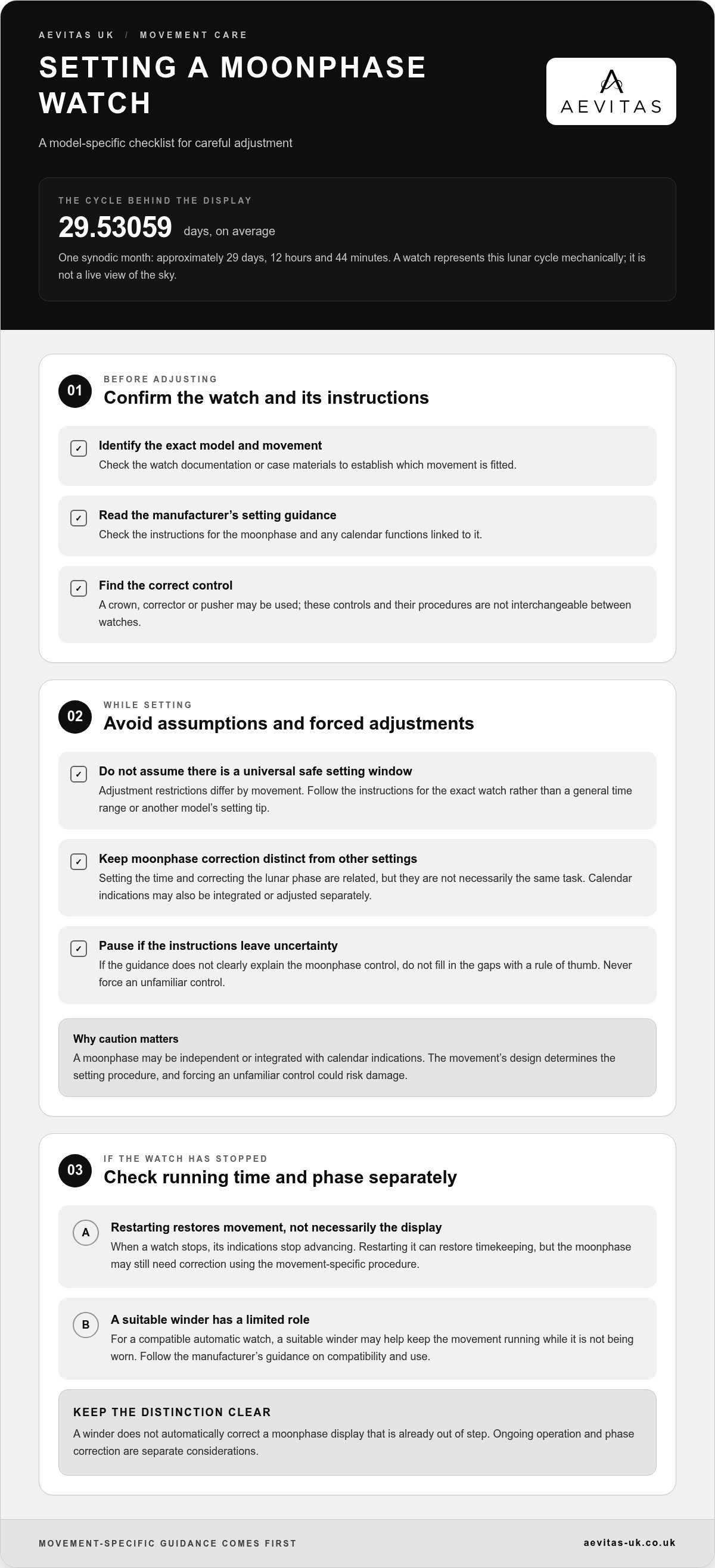
How to approach setting a moonphase watch without rushing
A careful correction begins before you touch the crown or corrector. There’s no universal sequence that applies safely to every moonphase watch. The manual for the exact calibre determines the correct setting sequence. Treat the steps below as checks to make before and after adjustment, not as instructions for operating a particular movement.
What to check before making any adjustment
First, identify the watch’s reference and movement using its documentation or case materials. Then find the manufacturer’s instructions for the moonphase and any linked calendar indications. Confirm which control serves each function, whether the watch must be in a particular condition, and whether any adjustment restrictions apply. Don’t infer these details from another watch that looks similar.
Before changing anything, note the displayed time and phase, and whether the watch is running. This gives you a clear record of the starting point and helps distinguish a timekeeping issue from a moonphase indication that needs correction.
A cautious adjustment process
Once you have the correct manual, follow its sequence precisely. Use only the control it identifies, and don’t add steps from a general guide or another model’s instructions. If any part of the procedure is unclear, stop and find the correct documentation before proceeding.
- Make each adjustment gently and only as described by the manufacturer.
- Stop immediately if a control resists, feels abnormal or produces an unexpected result.
- After the procedure, check the time, date and moonphase indications against a reliable reference, following any final checks specified in the manual.
A lunar calendar can help you compare the displayed phase with the current one, but it doesn’t tell you how to operate the watch. The manual remains the authority for the mechanism and its adjustment sequence. If the display still appears out of step, don’t keep pressing or turning controls in the hope that repeated attempts will correct it.
This measured approach is central to avoiding setting a moonphase watch incorrectly: identify the movement, understand its permitted adjustment conditions, and follow the instructions for that specific calibre. Suitable storage and winding may support ongoing care, but neither replaces the correct setting procedure.
For compatible automatic watches, explore automatic watch winders from Aevitas UK as one option for keeping a watch running between wears. Always follow the watch manufacturer’s guidance on winding and operation.
Keeping a moonphase watch accurate: manual correction, winding and storage
Accuracy over time depends on correct adjustment and appropriate ongoing care. If the moonphase display is already out of step, first consult the instructions for that exact watch. A winder may keep a compatible automatic movement running, but it won’t reset a phase indication that has already fallen behind. These are separate tasks: correcting the display restores its indicated phase, while winding supports the movement’s operation.
Can a watch winder help maintain a moonphase display?
For a compatible automatic watch, a suitable winder may help keep the movement running between wears. Whether it’s appropriate, and which winding direction or settings to use, depends on the watch. Follow the manufacturer’s guidance rather than assuming one setting suits every movement or complication. A winder supports ongoing operation; it isn’t a substitute for the watch’s moonphase-setting procedure.
Explore automatic watch winders from Aevitas UK for compatible watches. For a closer look at winder design and use, read this guide to carbon fibre watch winders. Neither a particular material nor a winder alone guarantees moonphase accuracy.
When should a collector correct the display or seek guidance?
If the watch has stopped or the display no longer matches the current phase, check its manual before making an adjustment. Confirm the control, permitted conditions and sequence for that movement. If the instructions are missing or a control behaves abnormally, don’t force it or continue experimenting. Pause and consult the watch’s manufacturer before proceeding.
Once the display is correctly set, suitable winding may help a compatible automatic watch continue advancing its indications. If the watch is stored rather than wound, a presentation box can keep it organised, but storage alone doesn’t maintain timekeeping or phase accuracy. Browse watch storage boxes from Aevitas UK for an organised place to keep a collection.
For compatible automatic-watch storage options, explore watch winders from Aevitas UK. The principle behind avoiding setting a moonphase watch incorrectly remains simple: use the manual for correction, and treat winding and storage as separate parts of ongoing care.
Care for the complication with confidence
A moonphase display is more than a decorative detail, and correcting it calls for care. The key to avoiding setting a moonphase watch incorrectly is to identify the exact movement and follow its manufacturer’s instructions, rather than relying on a universal sequence or time window.
Remember that winding and correction serve different purposes. A suitable winder may help keep a compatible automatic watch running, but it won’t reset a display that’s already out of step. Check the watch’s guidance before adjusting it, and pause if a control resists or behaves unexpectedly.
Thoughtful storage supports an orderly collection, while a suitable automatic winder can be part of ongoing care for compatible watches. Aevitas UK offers carbon fibre watch winders alongside storage options including watch boxes and stands. Explore Aevitas UK’s watch winders and storage to find an option for your collection. With the right instructions and a measured approach, you can enjoy the complication with greater confidence.
Frequently Asked Questions
Is it safe to set a moonphase watch at any time?
No. Don’t assume there’s a universal safe time to adjust a moonphase display. Some movements have adjustment restrictions, and the permitted conditions depend on the watch’s design and calendar functions. Check the manufacturer’s manual for the exact model before using a crown, corrector or pusher. If the instructions aren’t clear, pause rather than relying on a time window recommended for another watch.
Can setting a moonphase watch damage its movement?
It can, particularly if you force a control or make an adjustment contrary to the manufacturer’s instructions. The risk and possible consequences depend on the movement, so don’t assume every watch responds in the same way. Use only the control and procedure specified in the manual. If the control resists, feels unusual or produces an unexpected result, stop instead of applying more pressure.
How do I know which control adjusts the moonphase on my watch?
Check the instructions for your watch’s exact model and movement. A crown may have several functions, while a corrector or pusher may serve a particular indication. Their appearance alone doesn’t confirm what they do. Identify the watch reference from its documentation or case materials, then use the manufacturer’s guidance to match each control to its function before making an adjustment.
What happens if my moonphase watch stops running?
If the watch stops, its movement no longer advances the time or moonphase indication. Once restarted, the time may need setting and the displayed phase may also need correction. These are separate adjustments, so restoring timekeeping won’t necessarily bring the moonphase back into step. Consult the model-specific manual before correcting either indication, especially if the watch has additional calendar functions.
Can a watch winder keep a moonphase watch accurate?
A suitable winder may help keep a compatible automatic watch running, which can reduce the need to reset indications after the watch stops. Follow the watch manufacturer’s guidance for compatibility, winding direction and settings. A winder doesn’t correct a moonphase display that’s already wrong, and it can’t guarantee that every time or calendar indication remains accurate. Use the manual for any required adjustment.
Do all moonphase watches use the same setting procedure?
No. Controls, movement designs and connections to other calendar indications vary between watches, so one model’s sequence may not suit another. A cautious approach to avoiding setting a moonphase watch is to identify its exact reference and movement, then follow the matching manufacturer’s instructions. Don’t transfer a setting tip from a similar-looking watch or rely on a general guide for operating steps.
How often does a moonphase watch need correcting?
There’s no single correction interval for every moonphase watch. How often it may need adjustment depends on the movement’s design and accuracy, as well as whether the watch has stopped and how long it was not running. Check the display against a reliable lunar reference and consult the manual for correction guidance. Avoid adjusting it simply because a set amount of time has passed.