

The most impressive bedside table watch stand isn’t necessarily the right one for your routine. A sculptural design may suit a single watch worn every day, while a wider stand could take up more room than your bedside table allows. The best choice balances presentation, footprint and how you store your watch overnight.
It’s natural to want a cherished timepiece close at hand and beautifully displayed, rather than left loose on a hard surface. A stand offers open, accessible display; a watch box provides enclosed storage; and a watch winder has a different role, keeping a compatible automatic watch moving. Each format suits a different need.
This guide compares bedside watch stands by display style, capacity, materials and dimensions. You’ll learn when a stand makes more sense than a box or winder, and how finishes such as marble bases and leather supports can complement your bedside setting. Use the practical checks below to find a stand that works for both your collection and your nightly habits.
Key Takeaways
- Choose a stand around your nightly routine: prioritise quick access for a watch you wear often, or enclosed storage for a more contained setup.
- Measure the usable bedside-table surface before comparing stands, and leave room to place and lift your watch comfortably.
- Match the stand’s capacity and support style to the watches you use regularly. Fit can vary between timepieces.
- Compare finishes such as marble and leather with your bedroom furniture for a display that feels considered rather than crowded.
- Explore Aevitas Watch Storage’s individual and double stands if open display suits your needs, or choose a watch box when enclosed storage is the priority.
What Does a Bedside Table Watch Stand Add to Your Nightly Routine?
A bedside watch stand provides an open, accessible place to set and display a watch between wears. Instead of leaving a timepiece loose on a hard surface or among keys and other belongings, you give it a dedicated resting place that’s easy to reach in the morning.
That purpose distinguishes a watch stand from a general valet tray or phone docking station. A tray gathers everyday items, while a dock is arranged around a phone and its charging needs. A stand is shaped to support a watch, making it simple to take off at night and put back on in the morning. It can also make a frequently worn piece part of the bedside setting. The broader tradition of keeping personal accessories close at hand is reflected in the clothes valet, a furniture stand designed to hold clothing and accessories.
Bedside stand, watch box or watch winder: what is the difference?
An open stand displays a watch and keeps it accessible, but it doesn’t enclose it. A watch box holds watches in a covered or enclosed arrangement, which may suit someone who wants several pieces stored together rather than on display. A watch winder has a separate function: it moves a compatible automatic watch between wears. A stand doesn’t wind a watch.
Start by deciding what you need the accessory to do. For open bedside display, browse Aevitas UK’s luxury watch stands, available in individual and double formats. If keeping several watches in enclosed storage matters more than immediate display, choose a watch box instead.
Who benefits most from keeping a watch on a bedside stand?
A bedside stand suits someone who regularly wears the same watch and wants a consistent place to put it at night and pick it up in the morning. Its value is accessible placement and display, not enclosing or winding the timepiece.
Collectors who rotate between several watches may prefer to keep more of their collection together in a box, while using a stand for the watch worn most often. Consider your nightly habits, available bedside space and how many watches need to be within easy reach. If a stand would crowd the surface or leave other watches without a suitable home, enclosed storage may fit your routine better. For one regularly worn timepiece, an open stand offers a simple, deliberate place to return it at the end of the day.
How to Compare Bedside Watch Stands by Fit, Footprint and Finish
A well-chosen bedside table watch stand should fit both the watch and the surface it occupies. Compare the details that affect everyday use, rather than judging by appearance alone.
| Factor | What to compare | Why it matters |
|---|---|---|
| Capacity | Single or double support | Choose for the watches you regularly wear at home, not the full collection by default. |
| Footprint | Overall base width and depth | Check how much usable bedside-table space remains around the stand. |
| Support | Cushion shape, height and position | These affect how the watch rests and how easily you can lift it away. |
| Materials | Base and watch-contact surfaces | Consider the visual contrast and how each finish sits with your room. |
| Access | Space to place and retrieve each watch | A compact arrangement should still feel straightforward in your nightly routine. |
What measurements should you check before choosing a bedside stand?
Measure the clear surface available, not just the full width of the bedside table. Allow room for the items you use each night, then compare the remaining space with the stand’s published base dimensions. Measurements are specific to each design. For example, Smith & Rowe’s published dimensions describe its own stand-and-tray product, not a standard size for watch stands.
Next, consider the support’s height and shape alongside your watch’s case and bracelet. A broad case, a loose bracelet or a particular strap may rest differently from a slimmer watch. Use product-specific measurements where available, and assess the arrangement rather than assuming one support suits every timepiece.
Should you choose a single or double watch stand?
A single stand keeps the footprint focused if you take off and put on one watch most days. A double format may suit a routine that regularly alternates between two timepieces, keeping both visible and close at hand. It needs more surface space, so compare its base dimensions with the available area before deciding.
For a concrete comparison, Aevitas UK offers a double watch stand in white marble with dark violet veins and black leather. Its materials make finish part of the decision as well as capacity: consider how the marble and leather look beside your furniture and other bedside objects. Aevitas UK’s stands also include marble bases with black leather supports, giving you distinct finishes to compare alongside the practical fit.
Open Display or Enclosed Storage: Which Bedside Option Suits Your Watch?
An open stand keeps a watch visible and ready to pick up, but it isn’t a watch box. It doesn’t enclose the timepiece or serve as a security device. The choice comes down to your routine: do you want your regularly worn watch on display, or would you rather keep several watches together in a more contained arrangement?
| Format | Advantages | Trade-offs | May suit |
|---|---|---|---|
| Open stand | Visible presentation and convenient access | Watch remains on display, not enclosed | Someone who reaches for the same watch regularly |
| Watch box | Several watches can be kept together in a covered or enclosed format | Less immediate display; opening the box is part of the routine | A collector who prefers watches stored together |
When does an open bedside watch stand make sense?
Choose open display if you take off one watch at night and want it in the same easy-to-reach place each morning. You can see the watch between wears instead of putting it out of sight in a box. The trade-off is clear: a stand is not an enclosure, so choose it for placement and presentation, not as a substitute for contained storage.
For a specific finish, consider this black marble-base watch stand, which combines a marble base with a black leather support. Its material contrast may suit a bedside setting where the stand is intended to remain visible.
When is a watch box a better fit for your routine?
A watch box may make more sense if you rotate between several watches and prefer to store them together rather than leave them on display. It creates a more contained arrangement, but it isn’t automatically a guarantee against damage or a security device. Consider where the box will sit, how many watches you want to store and whether opening it each time fits your daily habit.
Neither format is universally better. A stand prioritises visibility and quick access; a box prioritises a shared, enclosed place for multiple watches. Choose according to how you use your collection and the bedside space available. If your routine calls for both, an open stand for your most-worn watch can sit alongside a box for the rest.
How to Choose a Bedside Watch Stand for Your Collection and Interior
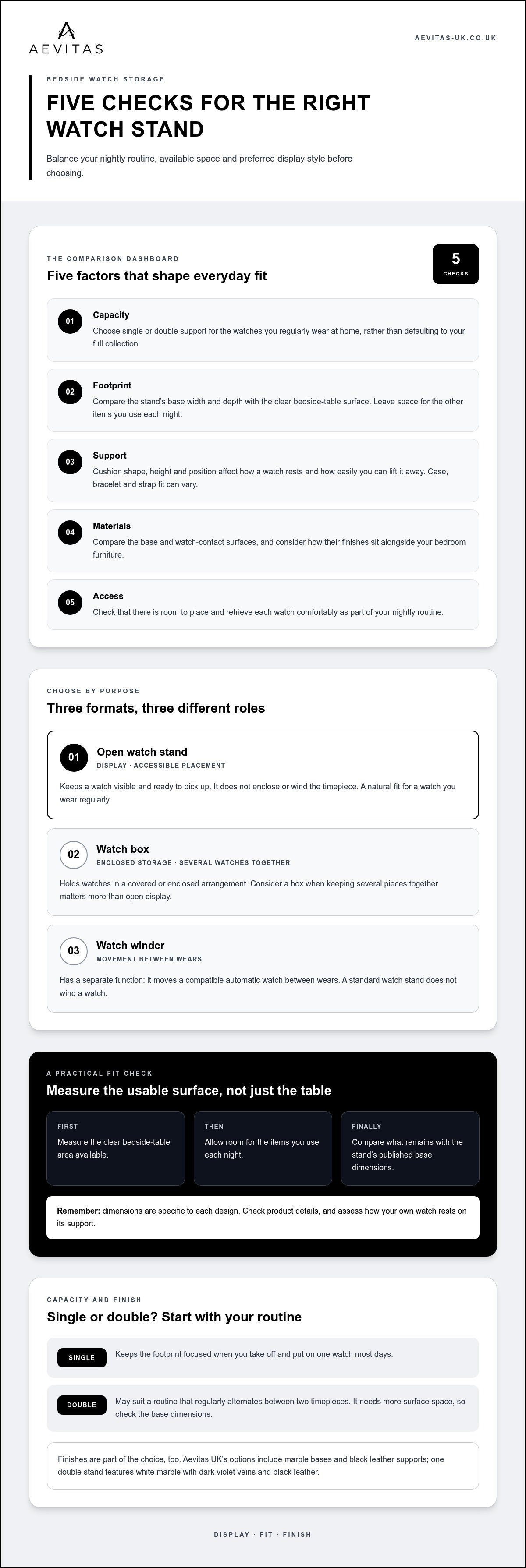
Choose in sequence: identify your nightly routine, count the watches that need a regular place, measure the usable bedside surface, then compare the support style and finish. This keeps an elegant choice practical. The right bedside table watch stand should suit both the timepiece you wear and the space where it will sit.
Match the stand to your watch and bedside space
Decide whether you need a place for one regular watch or for two that you rotate between. Measure the clear area on your bedside table, then compare it with the stand’s published base dimensions. Measurements apply to each specific design, so don’t use one product’s dimensions as a guide to another.
Consider how your watch’s case, strap or bracelet sits against the support’s shape and height. The Rolex Submariner is a useful example of a watch with a distinctive profile. Rolex traces the model’s introduction to 1953, and its enduring design is associated with a prominent rotating bezel and Oyster bracelet. Those details give it a different visual profile from a slim dress watch on a leather strap. Rolex’s Submariner page offers context on the model; its proportions are an illustration, not proof that it will fit a particular stand. Assess your own watch against the product’s support arrangement.
Use this short sequence before choosing:
- Routine: decide which watch or watches need an overnight place.
- Capacity: compare individual and double formats with that regular use.
- Footprint: measure the available surface and check published dimensions.
- Proportions: consider how the watch’s case and strap or bracelet will rest.
Choose a finish that works with the room and collection
A stand’s finish influences how the watch is presented. Aevitas UK’s options include marble bases with black leather supports, including black marble with brown veining and white marble with dark violet veins. The veining and contrast create different visual effects, but don’t imply a particular performance benefit.
Look at the stand alongside your bedside furniture, lighting and watch. A darker base may stand out against a pale surface, while a lighter, veined finish can bring another colour and pattern into the arrangement. These are matters of personal style; the practical checks remain the stand’s capacity, dimensions and fit with your timepiece.
Once you’ve settled on routine, space and finish, compare Aevitas UK’s luxury watch stands across individual and double formats.
Explore Aevitas Bedside Watch Stands and Choose Your Display Style
The selection criteria point to a straightforward choice: how many watches need a place, how much room is available, and whether you prefer visible display or enclosed storage. Aevitas UK offers individual and double watch stands, including designs that pair marble bases with black leather supports. Compare these open-display formats against your routine and bedside space.
Compare individual stand styles and materials
If one watch is your regular choice, an individual stand keeps the display centred on that timepiece. One design pairs white marble with dark violet veining and a black leather support. The stone’s lighter ground and visible veining create a different look from a darker base, while the black leather provides a consistent supporting detail. These are aesthetic distinctions, not claims about how a stand will perform with every watch.
Consider the watch alongside the material. A dark dial or bracelet may stand out against a lighter base, while a contrasting colour can make the arrangement feel more expressive. Aim for visual balance: the stand should complement the timepiece without taking over the bedside setting. Compare the white marble watch stand with other finishes, keeping your available surface and the watch’s proportions in mind.
Consider the wider watch-presentation context
A bedside display is part of a regular routine: placing a watch down at night and reaching for it again in the morning. A desk display may be seen throughout the day alongside work items, so its position and surrounding space can affect which format feels appropriate. The same watch may suit either setting, but the intended location helps determine the stand’s role in the room.
If you’re deciding between these locations, the desk watch stand guide explores presentation away from the bedside. For a timepiece you wear often, an open stand keeps it visible; if you’d rather store several watches together out of view, enclosed storage may suit you better.
Choose according to your collection rather than a universal idea of the perfect stand. An individual format may suit one frequently worn watch, while a double stand gives two regular choices a shared display. Once you’ve decided on routine, fit and finish, browse Aevitas UK’s luxury watch stands to compare styles and find a considered match for your bedside table.
Choose a Stand That Fits Your Routine
The right bedside table watch stand brings order to the end of the day and keeps a regularly worn watch easy to reach. Start with how many watches you use, measure the space available, then consider how the support suits your timepiece and how the finish complements your room.
Keep the format in mind, too. An open stand is for visible display and convenient placement; a watch box is better suited to keeping several watches together in enclosed storage. It doesn’t have to be an all-or-nothing choice: display your daily watch and store the rest of your collection separately.
Aevitas UK offers a dedicated collection of individual and double stand options, including designs that pair marble bases with black leather supports. Compare the formats and finishes, then choose the one that suits your bedside and nightly habits. Explore Aevitas UK’s collection of luxury watch stands and find a considered place for your timepiece.
Frequently Asked Questions
Can I leave my automatic watch on a bedside stand overnight?
Yes. A bedside stand can provide a convenient place to rest and display an automatic watch overnight, but it won’t wind it. Whether the watch needs winding depends on your wearing routine and the requirements of that particular model. Automatic watches don’t all need a winder between wears. For model-specific care, follow the guidance provided by the watch manufacturer rather than assuming an overnight rest requires additional winding.
Does a bedside watch stand keep a watch wound?
No. An ordinary open stand holds a watch in place, but it doesn’t provide winding action. If you’re considering winding functionality, distinguish a stand from a watch winder before choosing. Whether a winder suits you depends on the watch and how often you wear it. Consider your routine and the manufacturer’s care guidance when deciding between the two formats.
How do I choose the right size bedside watch stand?
Measure the usable bedside-table surface, then compare it with the specific stand’s published dimensions. Allow for other items you keep nearby, as well as enough room to place and lift your watch comfortably. Consider the watch’s case and how its bracelet or strap rests on the support. Fit varies by product, so check the measurements and design details for the individual stand rather than relying on a general size.
Is a watch stand or watch box better for a bedside table?
Neither is universally better; the right choice depends on your routine. A stand keeps a regularly worn watch visible and accessible, while a watch box suits someone who prefers watches grouped in enclosed storage. Consider how many watches you use, the space available and whether you want the timepiece on display. Neither format should be treated as a guarantee against theft or damage; choose according to the function it’s designed to provide.
Can one bedside watch stand hold more than one watch?
Yes, some stands are designed for more than one watch, but capacity depends on the particular design. Aevitas UK offers individual and double stands, so check the product description and images to see how many watches a particular stand is designed to hold. Match capacity to the watches you regularly take off and put on at home. A larger stand isn’t automatically more useful if you only need a place for one timepiece.
What should I put beside my watch on a bedside table?
Keep the surface organised around your evening routine: give your watch a dedicated place, then add only the other essentials you use. A separate tray may suit you if you want to group small personal items, while a watch-only stand keeps attention on the timepiece. Check what a specific product includes before expecting it to hold other belongings. A clear, practical arrangement makes it easier to return your watch to the same place each night.
Is an open watch stand suitable for storing a valuable watch?
An open stand is intended for placement and display, not enclosed or secure storage. It keeps a watch visible and accessible, but doesn’t put it out of view inside a box. If you prefer to store several watches together or want them enclosed, a watch box or another storage format may better match your routine. Don’t assume a stand or box guarantees protection from theft or damage; consider each product according to its stated purpose.