

What if the device you bought to preserve your watch is actually the greatest threat to its accuracy? Many collectors unknowingly risk the precision of their automatic movements by choosing storage solutions based on price rather than engineering. Recognising the signs of a bad quality watch winder is essential if you want to avoid the high costs of unnecessary servicing or mechanical failure. It's a mistake to assume any rotating box is safe for a high-end calibre.
You probably share the common fear of magnetising a delicate movement or the frustration of a noisy motor that disrupts the calm of your home. We understand that navigating technical specifications like TPD settings can be confusing when you simply want your timepiece ready to wear. This guide will show you how to identify subtle red flags before they cause lasting damage to your collection. You'll gain a clear checklist of what to avoid, ensuring you have the confidence to select a winder that extends the life of your luxury investment through proper motor shielding and technical precision.
Key Takeaways
- Recognise why a near-silent motor is a non-negotiable standard for protecting the delicate internal gears of your automatic watch.
- Understand the risks of magnetisation from unshielded motors and how to spot symptoms like sudden time deviations.
- Identify the physical signs of a bad quality watch winder, including flaking interior materials and cuffs that put undue pressure on your bracelets.
- Master the technical requirements of Turns Per Day (TPD) settings to ensure your mainspring remains optimally tensioned without excessive wear.
- Learn how superior engineering and motor shielding act as a safeguard for your luxury investment over the long term.
Why a Poor Quality Watch Winder is a Risk to Your Timepieces
A watch winder is far more than a display case that happens to move. It is a functional extension of your timepiece's internal architecture. To understand What is a Watch Winder?, one must view it as a precision instrument designed to maintain the mainspring's tension at an optimal level. A high-quality unit ensures your watch remains energised without triggering the slipping clutch mechanism too frequently. Conversely, an inferior device poses a direct threat to the winding rotor and the delicate gears it powers. Identifying the signs of a bad quality watch winder early can prevent a minor storage issue from becoming a major mechanical failure.
The psychological cost of using substandard equipment is often overlooked. For a serious collector, a failing winder is a source of persistent anxiety amongst a sea of precision instruments. Instead of offering the calm of a ready-to-wear collection, a budget unit leaves you questioning if the movement is being stressed or if the motor has stalled whilst you slept. There is a profound difference between a decorative box that rotates and a precision tool designed for movement preservation.
The Purpose of Precision Winding
Consistent rotation is vital for the longevity of a luxury movement. It ensures that specialised lubricants remain evenly distributed across the jewels and pivots, preventing the oils from congealing over time. Cheap gearing systems often suffer from "slipping," where the rotation becomes erratic or stops mid-cycle. This lack of consistency fails to keep the watch wound and can cause the rotor to vibrate unnaturally. A quality winder is a precision-engineered tool designed to preserve the mechanical health of a movement through controlled, rhythmic rotation.
Hidden Costs of Budget Alternatives
The allure of a low price point often masks the financial risks involved. Whilst a budget winder might save money upfront, the subsequent repair bills for a magnetised or overworked movement can easily exceed the cost of the winder itself. Most unbranded marketplace retailers offer no technical support or valid warranties, leaving you stranded when the unit fails. These cheap alternatives often succumb to motor fatigue within six months, as their internal components aren't rated for the weight of modern luxury timepieces. Investing in engineered watch winders provides the necessary protection and technical longevity that budget alternatives simply cannot match.
- Movement Stress: Poorly regulated rotations can lead to premature wear on the winding bridge.
- Motor Fatigue: Low-grade motors lack the torque to handle heavy platinum or gold watches.
- Lack of Support: Marketplace sellers rarely provide the expertise required for luxury calibre compatibility.
Mechanical Warning Signs: Motors, Noise, and Inconsistent Gearing
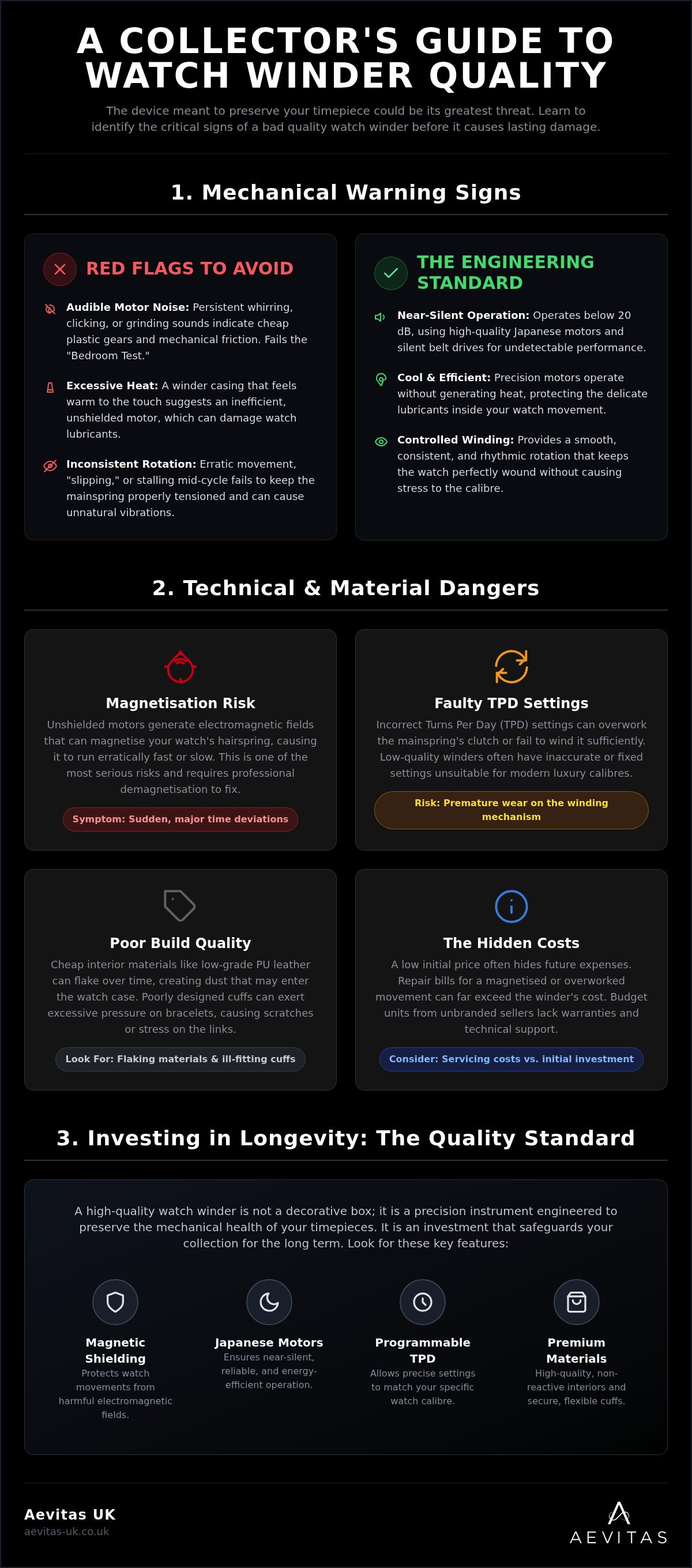
One of the most immediate signs of a bad quality watch winder is the failure of the "Bedroom Test." A precision-engineered winder should be virtually silent, operating at a level ideally below 20 dB. If you can hear a persistent whirring, clicking, or grinding sound whilst the device is active, it's a clear indicator of mechanical inferiority. These sounds often originate from the internal mechanics of a watch winder where cheap plastic gears are used instead of high-quality, silent belt drives. Over time, these plastic components wear down, creating friction that can lead to motor failure.
Beyond the annoyance of noise, a motor that generates heat is a major red flag for both fire safety and the health of your timepiece. Excessive heat can cause the specialised lubricants within your watch movement to thin or evaporate, leading to premature wear of the escapement. If the casing of your winder feels warm to the touch after a few hours of operation, it suggests a lack of electrical efficiency and poor motor shielding. For those seeking reliability, browsing premium watch winders designed with heat-efficient motors is a necessary step to safeguard your collection.
Deciphering Motor Noise
Clicking or rhythmic tapping sounds are amongst the most common signs of a bad quality watch winder. These noises usually suggest that the internal gearing is slipping or that the motor is struggling to maintain torque under the weight of the watch. High-end units typically utilise genuine Japanese Mabuchi motors, known for their longevity and near-silent operation. Unbranded alternatives lack this precision and often produce microscopic vibrations. Whilst these vibrations might seem negligible, they can interfere with the delicate balance wheel of a luxury calibre, potentially causing the watch to gain or lose time unnecessarily.
Inconsistent Rotation Patterns
A winder that stutters, pauses unexpectedly, or rotates at varying speeds is likely suffering from a failing power supply or an inferior circuit board. Consistency is paramount for maintaining the mainspring's tension. High-quality winders often feature a "Return to 12 o'clock" function, ensuring the watch is always presented in an upright, professional position when the cycle concludes. If your device lacks this feature or displays erratic movement, it indicates a lack of sophisticated control circuitry. These electrical inconsistencies are a precursor to total mechanical failure, often occurring within the first six months of use.
- Grinding Noises: A symptom of cheap plastic gears reaching their wear limit.
- Vibration: Poorly balanced motors that can disrupt the watch's escapement.
- Heat Emission: A sign of electrical strain that threatens the watch's internal lubricants.
Assessing Build Quality: Material Flaws and Poor Interior Design
External beauty can be deceptive. A winder might look premium in a photograph but reveal several signs of a bad quality watch winder upon closer inspection. Structural integrity is paramount for a device that rotates thousands of times each year. If the carousel wobbles or the hinges feel loose, the internal alignment is likely compromised. High-end models often utilise carbon fibre or solid wood. These performance materials do more than provide a polished aesthetic; they are essential for preventing resonance and dampening motor vibration that could otherwise transfer to the watch movement.
The Watch Cuff and Holder
Many budget manufacturers use "one size fits all" cuffs. These are often too large for smaller wrists or too stiff for delicate leather straps. A poor cuff puts constant strain on the spring pins and can permanently stretch a metal bracelet. You should look for adjustable or soft-touch holders that offer a secure locking mechanism. Without a lock, a heavy watch can slip forward, causing the crystal to rub against the viewing window. Ensure there is sufficient clearance for large cases, typically 44mm or wider, to avoid contact with the winder's internal walls.
Cheap faux-leather is a common culprit in substandard units. Over time, the synthetic surface degrades and flakes. These microscopic particles can migrate into the watch case through the crown or case back gaps, leading to a costly service. Premium winders use high-grade velvets or treated leathers that maintain their integrity for decades, protecting the watch from debris and scratches.
Exterior Finish and Longevity
Weight matters. A lightweight winder is often a warning. Weight usually correlates with the density of the chassis and the quality of the motor shielding. Inspect the exterior for bubbling veneers or uneven seams in the leather work. These are clear signs of a bad quality watch winder produced amongst high-volume, low-control environments. Finally, consider the viewing window. Whilst acrylic is common in budget models, it scratches easily and clouds over time. Genuine glass remains clear and offers superior scratch resistance, reflecting the quality of the timepiece it protects.
- Structural Integrity: Loose hinges and wobbling carousels indicate poor assembly.
- Material Degradation: Flaking faux-leather can contaminate the movement.
- Cuff Strain: Non-adjustable holders that stretch bracelets or damage leather.
The Technical Red Flags: Magnetisation and Faulty TPD Settings
Technical flaws are often invisible until your timepiece begins to lose its chronometer-grade accuracy. One of the most critical signs of a bad quality watch winder is the lack of proper motor shielding. Whilst a budget motor might rotate the watch, it simultaneously generates a magnetic field that can pull the delicate balance spring out of alignment. This invisible interference is the silent killer of movement precision, yet it is rarely mentioned by budget retailers focused on aesthetics over engineering.
Symptoms of a magnetised watch are distinct and frustrating. If your calibre suddenly gains several minutes per day, it's highly likely that the internal components have become magnetised. You can verify this at home using a simple compass. Place the compass on the winder whilst the motor is running; if the needle deflects, your winder is unshielded and actively harming your collection. Magnetisation is the most common cause of movement inaccuracy in winders.
Understanding Magnetic Interference
Premium manufacturers prioritise distance and shielding to isolate the movement from the motor's magnetic pull. High-quality winders use specialised shielding materials to contain the magnetic field within the motor housing itself. This level of engineering ensures that even the most sensitive vintage movements remain protected. For collectors who value technical safety, choosing shielded watch winder safes provides an essential layer of protection for high-value assets stored in a secure environment.
TPD and Directional Control
A generic winder with a simple on/off switch is a major red flag for any serious collector. Luxury watches have specific winding requirements that must be met to avoid mechanical stress. For instance, a Rolex Submariner generally requires 650 to 800 Turns Per Day (TPD), whilst a Patek Philippe Nautilus may need up to 1,800 TPD with bidirectional rotation. A winder that cannot be programmed to these specific settings will either under-wind the watch or force the slipping clutch to work overtime, leading to unnecessary internal wear.
High-quality circuit boards manage these cycles with precision, incorporating over-winding protection that allows the mainspring to rest between rotations. If you want to ensure your watch remains in peak condition, you should invest in a programmable watch winder that matches the exact directional and TPD requirements of your specific calibre.
- Directional Settings: Ensure the winder supports clockwise, counter-clockwise, and bidirectional modes to suit different movements.
- Programmable TPD: Avoid fixed-rate winders that cannot be adjusted to your watch's specific manufacturer recommendations.
- Motor Shielding: Verify that the motor is electronically isolated to prevent magnetic interference with the escapement.
Investing in Longevity: The Aevitas Engineering Standard
Aevitas has engineered a standard that systematically eliminates the technical failures found in generic marketplace devices. Whilst low-cost alternatives focus on high-volume production, our approach prioritises the mechanical longevity of your movement. Choosing luxury watch winders from a dedicated British brand ensures your collection is maintained by experts who understand the nuances of high-end calibres. Carbon fibre remains the ultimate material for this purpose. It offers exceptional structural rigidity whilst dampening microscopic vibrations that could otherwise interfere with a watch's escapement. This material prevents the resonance issues common in plastic units, ensuring your winder remains a silent companion to your collection.
The Aevitas Difference
Our commitment to silent motor technology ensures that even the most sensitive collectors can house their timepieces in a bedroom environment without disruption. Every unit features precision TPD programming, allowing you to match the exact directional requirements of a Rolex, Breitling, or Omega. We address the signs of a bad quality watch winder by implementing superior motor shielding, which prevents the magnetisation risks discussed earlier. Beyond the hardware, we provide global insured delivery and have built a reputation amongst collectors for unwavering quality and technical support. We invite you to explore our premium watch winders to see how professional engineering transforms storage into preservation.
Curating a Safe Collection
Transitioning from budget storage to a professional solution is a defining moment for any serious enthusiast. It marks the shift from simply owning timepieces to actively protecting their mechanical heritage. A winder should never be the weakest link in your collection's lifecycle. To understand the technical advantages of performance materials and how they benefit high-value movements, read The Ultimate Guide to Carbon Fibre Watch Winders. By avoiding the common signs of a bad quality watch winder and choosing a solution that meets the highest British engineering standards, you ensure your watches remain ready to wear and mechanically sound for decades to come. Protect your investment with the precision it deserves.
- British Engineering: Designed for compatibility with all major luxury watch brands.
- Performance Materials: Utilising carbon fibre to eliminate resonance and vibration.
- Motor Shielding: Advanced protection against magnetic interference.
Secure the Future of Your Timepiece
Identifying the signs of a bad quality watch winder is the first step in ensuring your automatic watches remain in peak condition. You now understand that a winder is a technical instrument where motor shielding and programmable TPD settings are as vital as the exterior finish. By prioritising silent operation and performance materials like carbon fibre, you eliminate the risks of magnetisation and mechanical strain that budget alternatives often ignore. These technical safeguards are essential for maintaining the accuracy of your movement over the long term.
Choosing a professional solution provides the calm and control every collector deserves. As the best-selling premium brand, Aevitas offers precision-engineered storage that is fully compatible with Rolex, Patek Philippe, and Omega movements. We provide free insured worldwide delivery to ensure your new winder arrives safely and ready to perform from day one. It's time to move beyond simple storage and invest in true movement preservation.
Explore the Aevitas Collection of Premium Watch Winders to find the perfect match for your collection. Your timepieces are a legacy; treat them with the engineering excellence they require to maintain their value for years to come.
Frequently Asked Questions
Can a bad quality watch winder damage my Rolex?
Yes, an inferior winder can certainly damage a Rolex by exposing it to unshielded magnetic fields or inconsistent rotation speeds. These technical flaws are common signs of a bad quality watch winder that lead to costly servicing. Whilst Rolex movements are robust, they aren't immune to the friction caused by poor TPD settings or the microscopic vibrations of low-grade motors. Choosing a precision-engineered solution is vital for long-term movement preservation.
How much noise should a luxury watch winder make?
A high-quality luxury winder should be virtually silent, typically operating at a decibel level below 20 dB. You shouldn't hear any grinding, clicking, or whirring even in a quiet bedroom at night. If the device is audible from a metre away, it suggests the use of cheap plastic gears or a motor with insufficient torque. Silent operation is a hallmark of premium engineering and effective motor shielding in professional units.
What are the signs that my watch has been magnetised by a winder?
The most common symptom of magnetisation is a sudden and significant gain in time, often several minutes per day. This occurs when the coils of the hairspring stick together due to magnetic interference from an unshielded motor. You can verify this by holding a simple compass near the watch; if the needle deflects, the movement is likely magnetised. This usually requires a professional demagnetiser or a watchmaker to correct the accuracy.
Why do some watch winders cost significantly more than others?
Price differences reflect the quality of internal components and materials used. Premium winders utilise Japanese Mabuchi motors, advanced motor shielding, and performance materials like carbon fibre to eliminate vibration. Budget alternatives often rely on unbranded motors and plastic gears that fail within months. The higher cost ensures your winder is a precision instrument rather than a decorative box, offering compatibility with all major luxury watch brands whilst protecting your investment.
Is it possible to over-wind an automatic watch on a budget winder?
Whilst most modern automatic watches have a slipping clutch to prevent over-winding, a budget winder can still cause excessive mechanical wear. If the winder lacks programmable TPD settings, it may force the clutch to engage continuously, leading to premature fatigue of the winding mechanism. High-quality winders include resting periods in their cycles to allow the mainspring to relax, mimicking the natural behaviour of wrist wear and extending the movement's life.
What motor brand should I look for in a high-quality winder?
Japanese Mabuchi motors are the industry standard for reliability and silent operation. They are designed to handle the weight of heavy luxury timepieces whilst maintaining consistent torque over many years. When assessing the signs of a bad quality watch winder, the absence of a reputable motor brand is a significant red flag. Aevitas utilises high-grade motors to ensure every rotation is smooth, quiet, and mechanically safe for your collection.
How do I know what TPD setting my watch requires?
You should consult your watch manufacturer's specifications or a reputable online TPD database to find the correct requirements. Most Rolex models require 650 to 800 TPD, whilst some Patek Philippe movements need significantly more. Using the incorrect setting can lead to an unwound watch or unnecessary mechanical stress. Premium winders allow you to customise these settings precisely to ensure your specific calibre receives the exact amount of energy it needs.
Are battery-operated winders less reliable than mains-powered ones?
Battery-operated winders are not inherently less reliable, provided the internal motor and circuitry are of high quality. They offer the benefit of being placed inside safes or display cabinets without cables. However, mains power is generally preferred for multi-watch winders due to the higher torque requirements of rotating multiple heavy watches. Many premium Aevitas models offer both options to provide collectors with maximum flexibility and consistent, reliable performance.