

The most sophisticated movement in your collection is only as reliable as the settings on your winder. Your luxury timepiece is an investment in precision, yet its longevity often hinges on a single, frequently misunderstood metric. You must master the specific watch winder turns per day your calibre requires to avoid the frustration of a stopped watch or the anxiety of mechanical stress. Generic manuals rarely provide the brand-specific data necessary for a truly refined collection.
Find Your Exact Model
Looking for the TPD setting for a specific watch? Browse our complete TPD database index — 117 watch models organized by brand, from Rolex and Omega to Seiko, Hamilton, and independent microbrands. Every model page includes the verified turns-per-day setting, winding direction, movement details, and our recommended winder.
You likely value the peace of mind that comes from knowing your horological investments are perfectly maintained. This guide provides the technical clarity needed to calibrate your programmable winder with absolute confidence. We will examine why 90% of luxury watches thrive between 650 and 800 TPD, decode the specific requirements for modern Rolex and Patek Philippe movements, and ensure your timepieces remain in a state of perpetual readiness. Master these settings to preserve the delicate isochronism and mechanical integrity of your finest pieces.
Key Takeaways
- Understand the mechanical science behind rotations and how they preserve the precision of your timepiece's mainspring.
- Identify the precise watch winder turns per day required for your specific calibre to maintain peak accuracy without unnecessary stress.
- Decode the directional requirements of luxury movements to ensure your winder is set to the correct clockwise, counter-clockwise, or bidirectional mode.
- Debunk the myth of over-winding and learn how modern slip-clutch mechanisms protect your movement from damage.
- Gain a step-by-step protocol for calibrating programmable winders to suit high-value collections, ensuring your timepieces remain in a state of perpetual readiness.
Understanding Turns Per Day (TPD) and the Science of Automatic Watches
Maintaining a luxury timepiece requires more than occasional wear. It demands an understanding of the mechanical requirements that keep a calibre functioning at peak performance. The primary metric for this is watch winder turns per day, which refers to the specific number of full 360-degree rotations a movement requires daily to remain fully wound. Whilst it might seem like a simple figure, TPD is a bespoke requirement dictated by the internal architecture of your watch.

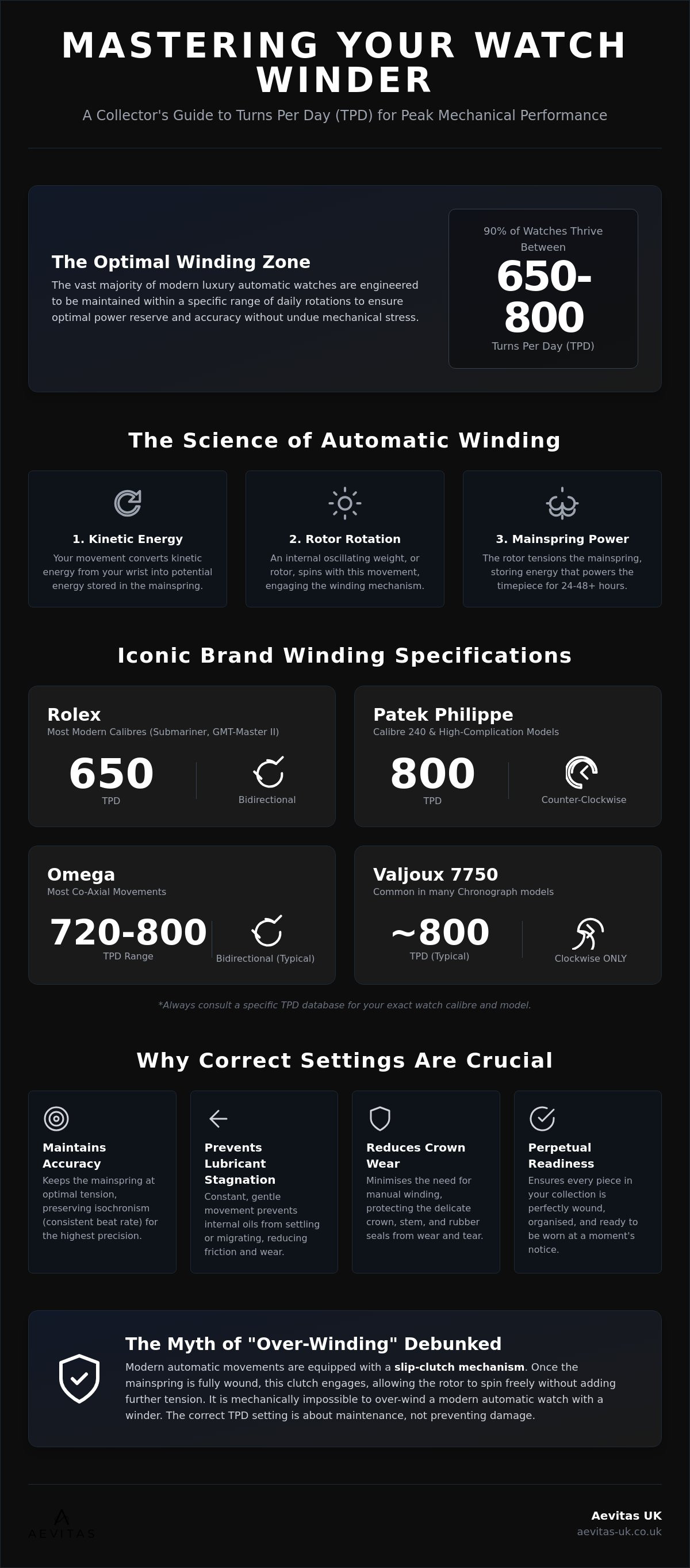
The core of an automatic watch is the oscillating weight, or rotor. As you move, this rotor spins, converting kinetic energy into potential energy stored within the mainspring. To grasp the science of automatic watches, one must appreciate that this energy transfer is not identical across all brands. A "one size fits all" approach to winding fails because different luxury calibres utilise varying gear ratios and mainspring tensions. A Rolex Submariner, for instance, is highly efficient and typically requires 650 TPD, whereas a complex Patek Philippe Calibre 240 demands 800 TPD in a specific counter-clockwise direction.
Consistency is the foundation of horological excellence. Professional collectors prioritise TPD settings to maintain isochronism. This is the ability of a watch to maintain a consistent beat rate regardless of how much tension remains in the mainspring. By keeping the watch consistently wound to its optimal level, you ensure the highest possible accuracy for your collection.
The Mechanics of the Automatic Winding System
The path of energy begins at the oscillating weight. This weight pivots on a central axis, sending torque through a series of reduction gears to the barrel arbour, which then tightens the mainspring. Some movements are unidirectional, meaning they only tension the spring when rotating in one specific direction. Others are bidirectional, capturing energy from every movement. The winding efficiency of a movement is the ratio of mechanical energy captured by the rotor to the specific TPD requirement needed to maintain a full power reserve.
Why TPD Settings Matter for Long-Term Maintenance
Precision winding is about protection as much as performance. Proper use of programmable watch winders prevents lubricant stagnation. If a movement sits idle for too long, the microscopic oils can settle or migrate, leading to increased friction when the watch is finally started. Furthermore, using a winder reduces wear on the winding crown and its delicate rubber seals. Constant manual winding can eventually compromise water resistance. Beyond the technical, there is the undeniable psychological benefit of a collection that is always organised and ready to wear at a moment's notice.
Decoding Your Watch’s Requirements: Brand and Movement Specifications
Identifying the correct watch winder turns per day is not a matter of guesswork. It requires technical precision. Most modern automatic watches find their "sweet spot" between 650 and 900 TPD, yet the exact figure depends entirely on the calibre's architecture. Whilst a brand name provides a useful starting point, the internal movement dictates the specific winding protocol. You might own two watches from the same manufacturer that require different settings due to their unique engineering and gear ratios.
Directional requirements are just as vital as the rotation count. Some movements, such as the venerable Valjoux 7750, only wind in a clockwise direction. Others require counter-clockwise or bidirectional rotation to engage the mainspring. To truly appreciate the science of timekeeping, one must understand how these rotors interact with the barrel arbour. If your setting is incorrect, the rotor will spin freely without tensioning the spring, leaving your watch dead by morning. For a comprehensive list of specific requirements, you should consult a watch winder settings database to verify your specific model's needs.
Standard Settings for Iconic Luxury Brands
Rolex sets a high bar for mechanical efficiency. For almost all modern calibres, including the Submariner, GMT-Master II, and Daytona, 650 TPD with bidirectional rotation is the verified standard. Omega Co-Axial movements typically require a slightly higher range, often between 720 and 800 TPD. Patek Philippe demands even more specific attention. The Calibre 240, found in various high-complication models, requires 800 TPD in a strictly counter-clockwise direction. Breitling models vary significantly; older ETA-based movements may differ from their modern in-house B01 calibres.
The Impact of Complications on Winding Needs
Complications increase the functional stakes. A perpetual calendar or moonphase watch is a marvel of horology, but resetting these displays after a power loss is a laborious task. A reliable winder is an absolute necessity for these pieces to preserve their calibration. Contrary to common myths, chronographs don't necessarily require significantly more TPD than standard three-hand models unless the movement is exceptionally complex. High-beat movements may require more torque to overcome mainspring tension, but the 650-900 TPD range remains the standard for 90% of the luxury market.
Selecting a programmable watch winder ensures you can tailor these precise settings to each individual piece in your collection, maintaining both accuracy and mechanical health.
Calculating the Ideal Setting: Addressing the Over-Winding Myth
A primary concern for many collectors is the risk of over-winding a delicate movement. You might worry that constant rotation will lead to a snapped mainspring or mechanical failure. This fear, whilst understandable, is largely unfounded in modern horology. Every automatic watch is equipped with a slip-clutch mechanism, specifically a sliding bridle, that prevents the mainspring from being over-tensioned. Once the spring reaches its maximum capacity, the bridle simply slides along the inner wall of the barrel. It's a sophisticated failsafe that ensures your investment remains protected.
However, "more is not always better" remains a vital principle. Whilst you cannot technically over-wind the watch, setting your watch winder turns per day significantly higher than required creates unnecessary mechanical stress. Excessive rotation increases friction between the sliding bridle and the barrel wall, which can lead to premature wear of the barrel's internal coating. Precision is about balance. You want to provide enough energy to maintain accuracy without subjecting the components to needless activity.
How the Bridle and Slip-Clutch Protect Your Watch
The sliding bridle is a specialised attachment at the end of the mainspring. Unlike the fixed attachment found in manual-wind watches, which provides a definitive "stop" when fully wound, the bridle is designed to slip under high torque. This is why manual winding an automatic watch feels like an infinite process; you're simply hearing the bridle move once the spring is full. Whilst over-winding is impossible, excessive TPD increases friction on the barrel wall, potentially necessitating more frequent servicing.
The Dangers of Under-Winding and Lubricant Health
Under-winding presents its own set of challenges. If a watch sits idle for months, it suffers from the "stagnation effect." Synthetic lubricants used in modern calibres are designed to stay in motion. When stationary, these oils can settle or thicken, leading to increased resistance when the watch is finally worn. A watch operating at the low end of its power reserve often suffers from reduced amplitude, causing it to lose precision. Using a premium watch winder ensures the movement stays in the "optimal torque zone," where accuracy is at its highest. High-end devices also include programmed rest periods or "sleep cycles." These cycles mimic the natural behaviour of a watch on the wrist, allowing the mainspring to unwind slightly and reducing constant tension on the gear train.
Calibrating Your Watch Winder: A Practical Setup Guide
Setting up your winder is an exercise in technical precision. It's not enough to simply place a timepiece on a rotating cuff; you must align the device with the specific mechanical needs of the movement. When organising a multi-watch winder with diverse calibre requirements, independent programmability is your most valuable asset. Each rotor must be adjusted to the exact watch winder turns per day required by its respective movement to ensure peak performance and longevity.
Collectors often encounter frustration when a watch stops despite being on a winder. This is rarely a mechanical failure of the device. It's usually a calibration error. To avoid this, you must follow a structured protocol for every new addition to your collection. Whether you are managing a modern chronograph or a delicate vintage piece, the goal is to maintain a consistent power reserve without subjecting the internal components to unnecessary activity.
The Discovery Protocol for Unknown Movements
If you own a vintage piece or a model from a micro-brand not found in standard databases, use a discovery protocol. Fully wind the watch manually before placing it on the winder. Start with a baseline setting of 650 TPD in bidirectional mode. Monitor the watch over a 48-hour period. If the time remains accurate, your setting is correct. If the watch stops or loses significant time, increment the watch winder turns per day to 800 or 950 and repeat the observation until the power reserve remains stable.
Managing Directionality and Turns
Directionality is as crucial as the rotation count. You must identify if your watch utilises a unidirectional or bidirectional winding rotor. A movement that only winds clockwise will never gain energy from a counter-clockwise programme. Whilst most collectors find that "Alternating" mode provides a versatile solution for general maintenance, specific calibres require dedicated settings. You should always consult your manufacturer manual for specific calibre-level data to ensure your settings are perfectly synchronised with the movement's architecture. For those with expanding collections, selecting a premium programmable winder is the only way to guarantee this level of bespoke care for every piece.
The Aevitas Standard: Precision Engineering for Discerning Collectors
Aevitas UK understands that a luxury collection is more than a hobby; it is a legacy of precision engineering. Maintaining that legacy requires a storage solution that respects the unique mechanical needs of every calibre. We prioritise independent programmability for every rotor in our multi-watch systems. This level of control is not merely a luxury. It is a technical necessity. As we have explored, your Rolex and Patek Philippe require distinct watch winder turns per day to maintain their accuracy and mechanical health. Our systems provide that exactitude with quiet confidence.
We marry high-end aesthetics with practical utility. Our carbon fibre finishes and luxury leather interiors reflect the craftsmanship of the timepieces they house. For collectors who prioritise both maintenance and protection, a watch winder safe offers the ultimate solution. These insurance-approved units provide a secure environment whilst ensuring your movements remain in a state of perpetual readiness. We remain committed to the British horological community, providing expert guidance and global insured delivery for every curator.
Why Programmable Winders are Essential
Budget winders often rely on fixed, non-adjustable rotation cycles. These generic programmes frequently fail to meet the specific requirements of complex movements, either under-winding the watch or causing unnecessary friction. Aevitas units allow you to programme the precise watch winder turns per day and direction your movement demands. Our motors are engineered for silent operation. This makes them ideal for placement in a bedroom or professional office. Furthermore, we utilise shielded motor housings to protect your delicate balance springs from potential magnetic interference, ensuring your watch's isochronism remains untainted.
Curating the Ultimate Storage Solution
A refined collection deserves a cohesive environment. Beyond our winding technology, we provide a range of high-quality storage options to suit every need. Integrating watch boxes and luxury stands allows you to organise your collection with the same care used to select the watches themselves. Accuracy in TPD settings is the hallmark of a professional collector. It ensures that every piece, from a vintage heirloom to a modern complication, is ready to wear at a moment's notice. Explore the Aevitas collection to find the perfect match for your timepieces and elevate your horological standards today.
Master Your Collection's Mechanical Integrity
Horological excellence is maintained through technical precision. You now understand that independent programmability is not an optional luxury but a fundamental requirement for any serious curator. By calibrating the specific watch winder turns per day for each calibre, you preserve the delicate isochronism and lubricant health of your finest pieces. This meticulous attention to detail ensures your collection is always organised and ready for immediate wear, regardless of how many complications your movements possess.
Aevitas UK remains the trusted advisor for collectors who value both heritage and modern engineering. As the UK's best-selling premium brand, we offer bespoke solutions compatible with all luxury calibres, from high-efficiency Rolex movements to the most intricate Patek Philippe complications. Elevate your maintenance standards today with a system designed for the discerning professional. Browse our range of precision-programmed watch winders and benefit from free insured delivery worldwide. Your timepieces represent a lifetime of achievement; give them the technical protection and sophisticated storage they deserve.
Frequently Asked Questions
Can a watch winder damage my automatic watch if the TPD is too high?
Modern automatic watches are equipped with a slip-clutch mechanism that prevents the mainspring from snapping. Whilst you cannot technically over-wind the watch, setting your watch winder turns per day excessively high creates unnecessary mechanical friction. This can lead to premature wear of the barrel's internal coating over several years.
How do I find the correct TPD setting for my specific watch model?
The most reliable method is to consult your manufacturer's technical manual or a verified horological database. If your specific model is not listed, start with a baseline setting of 650 TPD in bidirectional mode. Observe the watch over a 48-hour period to ensure it maintains accurate time and power reserve.
What is the difference between clockwise, counter-clockwise, and bi-directional winding?
Unidirectional movements only tension the mainspring when the rotor spins in one specific direction. Clockwise or counter-clockwise settings must match this internal architecture to be effective. Bidirectional movements are more efficient, capturing energy from rotations in either direction, which makes them compatible with almost any winder programme.
Is it better to leave my watch on a winder or let it stop when not in use?
Maintaining a gentle state of motion is generally superior for the long-term health of the movement. Consistent activity prevents synthetic lubricants from settling or migrating. It also reduces the frequency with which you must unscrew the crown, preserving the integrity of the delicate rubber seals and threads.
Do vintage watches require different TPD settings than modern ones?
Vintage movements often require more conservative settings due to their age and mechanical design. They may be less efficient than modern calibres or utilise specific unidirectional rotors that demand precise calibration. You should always use the lowest effective TPD setting for vintage pieces to minimise stress on ageing components.
Why does my watch still stop even though it is on a winder?
This issue is almost always caused by incorrect directional settings or insufficient watch winder turns per day. If a movement requires clockwise winding but the device is set to counter-clockwise, the rotor will spin freely without tensioning the spring. Verify your calibre's specific directional needs to resolve the problem.
Can a watch winder magnetise my watch movement?
High-quality winders utilise shielded motor housings specifically designed to eliminate magnetic interference. Magnetisation is typically only a risk with budget, unshielded devices. Premium motors are engineered to operate silently whilst protecting the delicate balance spring from any stray magnetic fields.
How many turns per day does a Rolex Submariner need?
A modern Rolex Submariner requires 650 TPD set to bidirectional rotation. This setting is standard for the majority of Rolex Perpetual calibres, including the GMT-Master II and the Daytona. It provides the optimal balance between maintaining a full power reserve and minimising mechanical wear on the sliding bridle.
0 comments