

The steel box you trust to guard your passport might be the very thing damaging your Patek Philippe. While a standard home safe provides a robust barrier against theft, it often lacks the specialised environment required for high-end movements. When debating a watch safe vs home safe, the choice isn't just about preventing a burglary; it's about preventing mechanical decay. You've invested significant time and resources into curating a collection that reflects your success. It's natural to worry about oils congealing or power reserves draining while your timepieces sit in a cold, static vault.
We recognise that a true collector seeks a storage solution that satisfies stringent UK insurance providers while maintaining the pristine condition of every calibre. This guide clarifies the critical differences between general security and dedicated horological protection. You'll learn how to navigate AiS-approved Eurograde ratings for 2026, the mechanical advantages of integrated winding, and how to select a safe that matches a luxury interior. We provide the clarity you need to ensure your collection remains secure, functional, and impeccably presented.
Key Takeaways
- Learn why the watch safe vs home safe debate is essential for maintaining mechanical integrity alongside physical security.
- Understand how Eurograde ratings and AiS approval dictate the level of insurance coverage available for your collection.
- Discover the necessity of integrated winding technology to prevent movement degradation and oil congealing.
- Identify the technical standards required for premium storage, including biometric security and mains power integration.
- Explore how specialised watch winder safes offer a refined solution that balances high-security engineering with luxury aesthetics.
Home Safe vs Watch Safe: Understanding the Fundamental Differences
The debate regarding a watch safe vs home safe often starts with a fundamental misunderstanding of the objective. For many, the goal is simply to prevent theft. A standard home safe is a utilitarian tool designed for this exact purpose. It functions as a secure repository for passports, deeds, and emergency cash. These units are built to withstand blunt force and, in some cases, extreme heat. When researching what is a safe, you'll find that traditional models prioritise volume and brute strength over the delicate requirements of horology.
A dedicated watch safe represents a shift from mere storage to active preservation. It combines the impenetrable exterior of a high-grade vault with an interior environment tailored for precision instruments. For the modern collector, this transition is essential. You are no longer just hiding valuables; you are organising and maintaining a curated collection. A general-purpose safe protects the financial value of your watches but often ignores their mechanical health and aesthetic condition.
The Limitations of Standard Home Safes
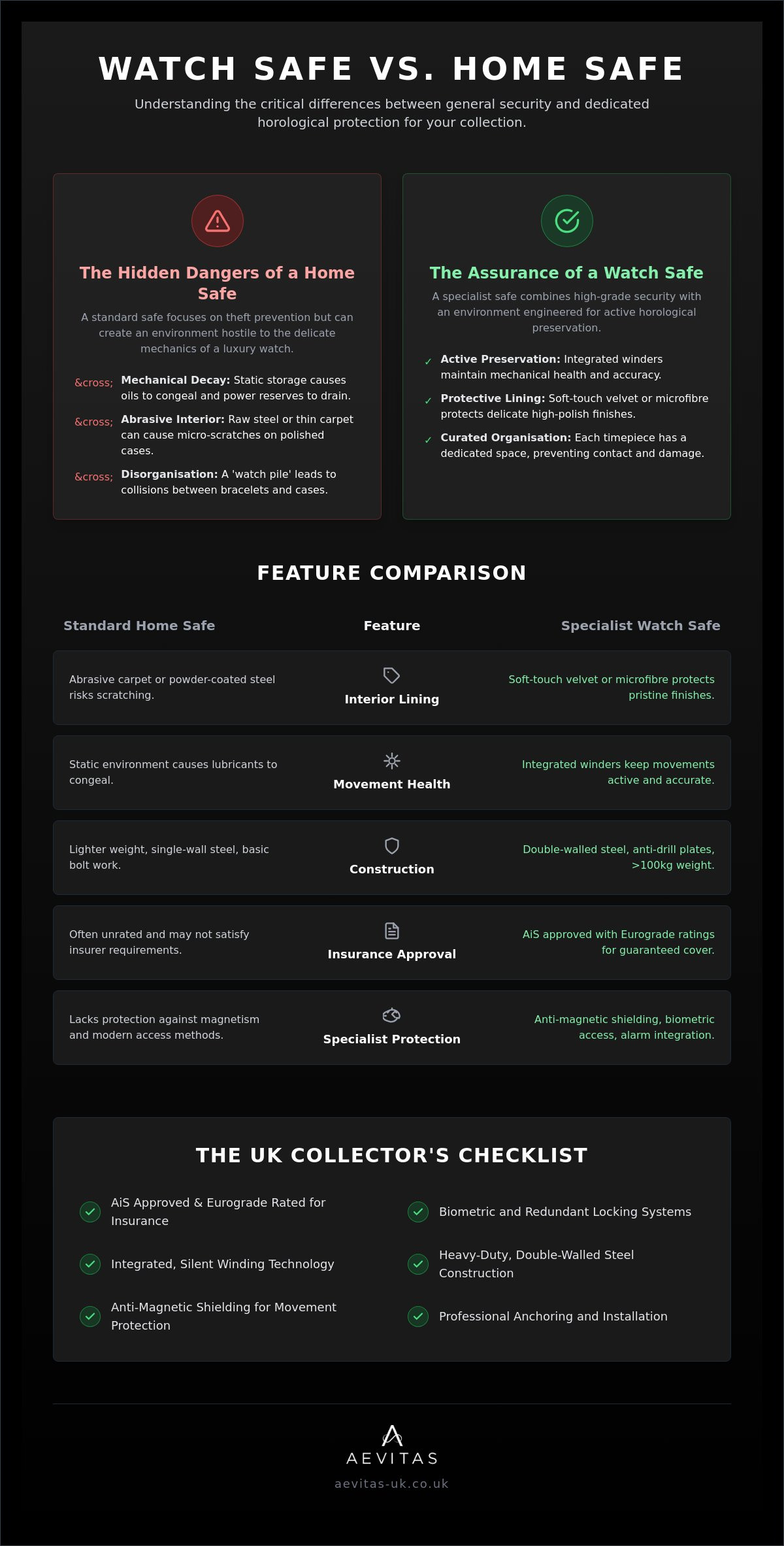
Standard home safes often feature industrial interiors that are surprisingly hostile to luxury timepieces. The linings are frequently made from thin, abrasive carpeting or raw powder-coated steel. Placing a polished gold or platinum case directly onto these surfaces can lead to micro-scratches. Without internal organisation, watches are often stored in a "watch pile" where bracelets and cases collide during daily use. Most critically, these safes are static environments. They offer no provision for automatic movements. When a mechanical watch sits stationary for extended periods, the lubricants can begin to congeal. This leads to increased friction and potentially expensive service requirements when the watch is finally worn.
The Evolution of Dedicated Watch Safes
A sophisticated watch winder safe is engineered to solve these specific problems. The interiors utilise soft-touch linings such as velvet or high-grade microfibre. These materials ensure that even the most delicate high-polish finishes remain pristine. Organisation is built into the design, providing each timepiece with its own dedicated space to prevent accidental contact.
The true evolution lies in the integration of silent winding technology. These systems maintain the power reserve of your collection, ensuring that perpetual calendars and moonphase complications stay perfectly synchronised. Modern designs also incorporate anti-magnetic shielding. This is a vital feature that protects delicate hairsprings from the magnetic fields generated by high-security locking solenoids. It's a professional-grade solution that respects both the emotional and financial value of your collection.
Comparing Security Features: Home Safes vs Luxury Watch Safes
A standard document box might protect your birth certificate from a house fire, but it offers little resistance against a determined intruder. When evaluating a watch safe vs home safe, the primary distinction lies in the engineering of the barrier itself. Luxury watch safes are constructed with double-walled steel and reinforced with anti-drill plates. These units are significantly heavier than entry-level home safes, often exceeding 100kg even in smaller sizes. This mass, combined with professional floor-anchoring, ensures the safe remains exactly where you installed it. Professional-grade safes also feature superior alarm integration, allowing the unit to be linked directly to your home security network.
The build quality of a luxury safe extends to the bolt work. Whilst a basic home safe might use thin, stamped metal tabs, a dedicated horological safe utilises thick, chrome-plated steel bolts that engage in multiple directions. This makes prying the door nearly impossible. For those seeking this level of technical precision, exploring a premium watch winder safe is the logical next step in securing a high-value collection.
Locking Technology and Access
Modern access methods have moved beyond the cumbersome traditional key. Biometric scanners are now a standard for the daily wearer. They provide near-instant access via a fingerprint, which is ideal when you're in a hurry but don't want to compromise on security. Digital keypads offer a different advantage; they allow you to organise unique codes for family members or trusted staff. Redundant locking systems are essential. They ensure that if the electronics fail or the battery dies, a high-security physical key override is available to prevent you from being locked out of your own collection.
Interior Protection and Environment
Standard home safes often feature abrasive interiors that cause micro-scratches on polished lugs and bezels. Over time, simply sliding a watch across a rough shelf can dull the finish of a precious metal case. Dedicated watch safes use non-reactive, soft-touch interiors like velvet or microfibre to prevent this aesthetic degradation. Protection also extends to the invisible environment. High-quality safes include anti-magnetic shielding. This ensures the safe's own locking solenoids or winding motors don't magnetise your watch's hairspring, a common issue that causes mechanical watches to run fast. Fire resistance is another critical factor; a proper safe should maintain a stable internal temperature even during a significant external fire event.
Insurance Approved Watch Safes: The UK Collector’s Checklist
Securing a high-value collection involves more than physical barriers; it requires a storage solution that satisfies the rigorous standards of British insurance providers. When evaluating a watch safe vs home safe, the deciding factor for many collectors is the insurance rating. UK insurers categorise safes based on their "cash rating," which is the amount of cash they are certified to protect overnight. For jewellery and watches, this figure is typically multiplied by ten. If a safe carries a £10,000 cash rating, it provides £100,000 of valuables coverage. Failing to match your safe's rating to the total market value of your collection can result in a voided policy or a rejected claim.
The Association of Insurance Surveyors (AiS) plays a pivotal role in the UK market. An AiS-approved safe has undergone independent testing to ensure its construction meets specific security benchmarks. Most high-net-worth insurers in 2026 will insist on seeing the AiS "Blue Ribbon" certificate before they agree to cover a significant horological asset. Utilising an approved safe doesn't just provide peace of mind; it can actively lower your annual premiums by demonstrating a proactive approach to risk management.
Eurograde Ratings Explained
Eurograde ratings are the international standard for safe security, ranging from Grade 0 to Grade 5 and beyond. Understanding these tiers is essential for selecting the correct level of protection:
- Grade 0: Provides up to £6,000 cash or £60,000 in valuables coverage. This is often the entry point for enthusiasts with a small, curated selection.
- Grade 1: Increases coverage to £10,000 cash or £100,000 in valuables. This grade is essential for protecting high-value brands like Patek Philippe or Audemars Piguet.
- Grade 2 and 3: Offer coverage up to £175,000 and £350,000 respectively. These are the preferred choices for established collectors with multiple high-complication pieces.
- Grade 4 and 5: Reserved for the most substantial collections, providing between £600,000 and £1,000,000 in valuables protection.
Working with British Insurers
Possessing a high-grade safe is only half of the requirement. For your insurance policy to remain valid, the safe must be professionally installed. Most insurers require any safe weighing less than 1,000kg to be securely anchored to a solid concrete floor or a brick wall using approved heavy-duty bolts. You should always document the installation process and keep a copy of the safe’s certification plate, which is usually found on the inside of the door. To ensure your storage meets these exacting standards, you can explore our range of watch winder safes for insurance-compliant solutions that blend high security with refined interior craftsmanship.
Key Features to Look for in Secure Watch Storage for Home
Selecting a storage solution involves balancing high-security engineering with the delicate needs of a mechanical movement. When weighing the benefits of a watch safe vs home safe, the internal functionality is often more important than the external dimensions. A primary consideration is the "heartbeat" of your collection. Automatic watches require consistent movement to maintain their power reserves and ensure internal lubricants remain fluid. In 2026, the most sophisticated safes move beyond passive storage to offer active horological care. They integrate technology that keeps your timepieces ready for the wrist at a moment's notice.
Power management is a critical factor that many standard security providers overlook. Operating electronics inside a thick steel vault presents a unique challenge. Whilst some entry-level units rely on internal batteries, these often fail unexpectedly, leaving your collection static. Premium solutions utilise a mains pass-through. This allows the safe to draw power from your home's electrical circuit, ensuring uninterrupted performance for your winding motors. It also powers internal LED systems, which provide essential visibility for selecting a piece in low-light environments. When planning your installation, always consider capacity for future acquisitions. A well-chosen safe should accommodate the collection you intend to build, not just the one you currently possess.
The Power of Integrated Watch Winders
Integrated winding systems allow you to customise the environment for every specific calibre in your possession. Different movements require different settings to avoid unnecessary wear on the mainspring. Professional-grade safes offer programmable Turns Per Day (TPD), ranging from 600 to over 1,000. They also provide directional control, allowing for Clockwise, Counter-Clockwise, or Bi-directional rotation. This level of precision is vital for maintaining complex perpetual calendars and moonphase complications. To understand the materials that best support these systems, you can learn more about carbon fibre watch winders and their performance in high-end environments.
Design and Material Excellence
Presentation remains a priority for the discerning collector. The interior of a dedicated safe should feel like a luxury boutique, not a hardware store. High-quality linings such as leather, Alcantara, or premium wood veneers provide a soft, non-reactive surface for your watches. These materials prevent the micro-abrasions often caused by the rough carpeting found in general-purpose home safes. Exterior finishes have also evolved; you can now choose from high-gloss lacquers that match your furniture or tactical matte steel for a more discreet profile. If you are ready to upgrade your home security, browse our specialised watch winder safe collection to find a model that aligns with your interior design and security requirements.
Why an Aevitas UK Watch Winder Safe is the Ultimate Choice
Choosing between a watch safe vs home safe often comes down to the level of expertise you require from your storage provider. Aevitas UK bridges the gap between high-security engineering and luxury horological care. We design our products specifically for the discerning UK collector who understands that security shouldn't come at the expense of mechanical integrity. Our watch winder safes aren't mere repositories; they're sophisticated environments that organise your collection for maximum accessibility and protection. We prioritise the transition from disorder to refinement, offering you a sense of calm and control over your most valued assets.
The engineering behind our safes prioritises the delicate hairsprings and precision gears of your watches. We utilise anti-magnetic shielding and low-vibration motors to ensure your timepieces are never compromised by the safe’s own internal mechanisms. This level of detail is what separates a professional watch safe from a generic home security box. Every unit we produce features a seamless integration of high-security steel and silent winding technology. This ensures your timepieces remain fully wound and ready for the wrist without the noise or vibration associated with inferior motors. We provide peace of mind through free insured delivery across the United Kingdom, ensuring your investment is protected from the moment it leaves our facility.
Bespoke Solutions for Every Collection
Collectors have diverse requirements that a standard home safe cannot meet. Our range provides bespoke solutions, from compact 2-watch safes for the budding enthusiast to expansive multi-winder cabinets for the serious investor. Each unit offers direct compatibility with all major luxury watch brands, including Rolex, Omega, and Breitling. We understand that your collection is a living entity that grows over time. Our storage solutions are designed to accommodate this growth, providing a scalable environment for your future acquisitions. You can view our full collection of watch winders and storage to find the configuration that best suits your current and future needs.
The Aevitas UK Commitment
We are dedicated to providing the highest standards of watch safety and security, utilising our extensive worldwide shipping expertise to deliver premium protection to collectors across the globe. Our team offers expert advice to help you choose the right Eurograde rating for your specific collection value. We understand the nuances of the UK insurance market and the technical requirements of modern mechanical movements. This expertise ensures you receive a storage solution that's both insurance-compliant and mechanically beneficial. Secure your collection with an Aevitas UK Watch Winder Safe today and experience the ultimate in horological protection.
Elevate Your Home Security with Professional Horological Protection
Choosing the right storage for your collection is a definitive step toward long-term preservation. The watch safe vs home safe debate isn't just about theft prevention; it's about maintaining the mechanical heartbeat of your timepieces through integrated winding and anti-magnetic shielding. By selecting an AiS-approved Eurograde safe, you ensure your collection meets the highest UK insurance standards while benefiting from a storage environment that prevents movement degradation and oil congealing. Aevitas UK remains the UK's best-selling premium watch winder brand, offering systems that are compatible with all major luxury watch movements.
Your investment deserves a solution that combines high-security steel with the refinement of a luxury interior. We simplify this transition by providing free insured delivery within the UK, ensuring your new vault arrives safely and discreetly. It's time to move beyond basic storage and embrace a system that organises, protects, and maintains your collection with quiet confidence. Secure your collection with an Aevitas UK Watch Winder Safe and enjoy the peace of mind that comes from professional-grade protection. Your timepieces deserve a sanctuary that reflects their exceptional craftsmanship.
Frequently Asked Questions
Is a watch safe better than a bank safety deposit box?
A home-based watch safe offers superior accessibility for the active collector. Whilst a bank provides high-level off-site security, it prevents you from wearing and enjoying your timepieces on a daily basis. Dedicated home units also include integrated winding technology to keep your movements healthy. Bank boxes are static environments that can lead to oil congealing over long periods of inactivity.
Do I really need a winder inside my safe for my automatic watches?
Integrated winders are essential if you own multiple automatic pieces or complex complications like perpetual calendars. They ensure your watches are always ready for the wrist and maintain the flow of internal lubricants. When comparing a watch safe vs home safe, the inclusion of winding motors is the primary mechanical advantage that prevents expensive service requirements in the future.
What Eurograde rating do I need for a collection worth £50,000?
A Eurograde 0 safe is the appropriate choice for a collection of this value. This rating typically provides up to £60,000 in valuables coverage, which offers a comfortable margin for your £50,000 collection. You should always verify the specific requirements of your insurance policy. Some providers may insist on a Grade 1 unit to allow for future acquisitions and market appreciation.
Can a watch safe be hidden inside a wardrobe or cabinet?
Discreet installation inside a wardrobe or bespoke cabinet is a popular choice for many UK collectors. The safe must be professionally anchored to a solid floor or wall to remain insurance-compliant. You must also ensure the chosen furniture can support the significant weight of a high-security unit. Mains power access is required if you intend to use integrated winding and LED lighting features.
Will the motors in a watch winder safe magnetise my watches?
Premium watch safes utilise shielded motors specifically designed to prevent magnetic interference. High-quality units are engineered with non-magnetic materials to protect delicate hairsprings from the safe's own electronic components. This is a critical distinction between professional storage and placing a budget winder inside a standard home safe. Professional shielding ensures your mechanical watches maintain their chronometric precision without disruption.
What happens if the digital lock on my watch safe runs out of battery?
You won't be locked out of your collection if the battery fails. Most professional safes include an external battery override point or a high-security physical override key. Modern digital locks also provide audible or visual low-battery warnings long before the power is completely exhausted. It is a reliable system designed with multiple redundancies to ensure you always have access to your valuables.
Are luxury watch safes fireproof as well as burglar-proof?
Many luxury safes offer certified fire resistance alongside their security ratings. These units utilise specialised fire-retardant materials between the steel walls to maintain a stable internal temperature. You should check the specific fire rating, such as 30 or 60 minutes of protection. This ensures your collection is guarded against environmental disasters as well as theft, providing a comprehensive protective environment for your assets.
How do I prove to my insurance company that my safe is 'approved'?
Insurers require evidence of the safe's certification and professional installation. You can find a certification plate, often featuring the AiS logo, on the inside of the safe door. Provide a clear photograph of this plate along with your receipt from a professional installer. These documents confirm the safe meets the required Eurograde standards and has been anchored according to the manufacturer's specifications.
0 comments