

What if the very way you store your timepieces is silently compromising their mechanical precision? For many collectors, the choice between a watch box vs watch winder is far more than a matter of simple organisation. It's a critical decision regarding the longevity of your horological assets. You likely know the frustration of reaching for a perpetual calendar or moonphase complication on a busy morning, only to find the movement has stalled. Resetting these intricate displays is tedious and creates avoidable wear on the crown and internal gears.
We agree that your collection deserves better than a cluttered nightstand or a dusty drawer. This guide promises to help you navigate the transition from disorder to refinement by identifying whether active maintenance or passive display suits your lifestyle. We will examine how different storage solutions protect against mechanical "gumming up" and surface scratches. You will gain a clear decision framework based on your specific movement types, ensuring your investment is maintained to the highest standards whilst elevating your home interior.
Key Takeaways
- Distinguish between passive aesthetic preservation and active mechanical maintenance to ensure the longevity of your timepieces.
- Identify why complex complications, such as perpetual calendars, necessitate the use of an automatic winder to prevent unnecessary wear.
- Evaluate the protective advantages of luxury presentation boxes for vintage collections and manual-wind movements.
- Utilise a clear decision framework for the watch box vs watch winder debate based on your specific movement requirements and storage space.
- Learn how advanced materials like carbon fibre provide a sophisticated, secure environment that meets modern horological standards.
Understanding the Fundamental Differences in Watch Storage
Choosing between a watch box vs watch winder isn't merely a matter of aesthetics. It's a strategic decision that impacts the longevity of your timepieces. Many collectors mistakenly believe these items are interchangeable; yet, they serve entirely different mechanical purposes. One offers a sanctuary for rest. The other provides a controlled environment for movement.

The Role of the Watch Presentation Box
A luxury watch storage box acts as a passive, protective display environment. It prioritises organisation and visual curation. These units are designed to shield your collection from dust, humidity, and accidental surface scratches. For manual-wind, quartz, and vintage timepieces, a box is often the most appropriate choice. It allows the movement to rest without any unnecessary mechanical stress. Beyond protection, a well-crafted box serves as a sophisticated centrepiece in a study or dressing room. It transforms a scattered collection into a curated gallery, elevating your home interior with a sense of refined order and quiet confidence.
The Function of the Automatic Watch Winder
An automatic watch winder is an active maintenance tool rather than a simple storage container. It's specifically engineered to support the automatic watch mechanism by simulating the natural motion of a human wrist. This constant, gentle rotation keeps the mainspring tensioned and ensures the watch remains ready for immediate wear. Continuous operation is vital for preventing lubricant stagnation. In high-end calibres, synthetic oils can settle and thicken if left dormant for months. This leads to increased friction and potential timing errors once the watch is eventually restarted.
For watches featuring complex complications like moonphases, sky charts, or perpetual calendars, a winder is a matter of practical necessity. Resetting these intricate displays after a power reserve has depleted is time-consuming. It often requires a delicate touch to avoid crown wear. Your choice in the watch box vs watch winder debate should always be driven by horological health. You must determine whether your specific movement requires the mechanical engagement of a winder or the stable, secure environment of a premium presentation box. It's about matching the storage solution to the technical demands of the calibre.
When an Automatic Watch Winder is Essential
If your collection includes high-complication timepieces, the decision between a watch box vs watch winder is often dictated by technical requirement. A winder is indispensable for the collector who rotates through three or four daily favourites. It eliminates the tedious task of winding and setting each piece before leaving the house. It's about maintaining a seamless transition from your storage to your wrist.
Preserving Complex Complications
Resetting a perpetual calendar or a moonphase complication is a delicate operation. Frequent manual adjustments increase the risk of damaging the movement's intricate gear trains, particularly if adjustments are made during the movement's internal date-change cycle. A winder ensures your watch is ready to wear at a moment's notice, maintaining the correct date and lunar phase without human intervention. TPD, or Turns Per Day, is the specific metric used to synchronise the winder's rotation with the movement's winding requirements. Most modern movements, such as those from Rolex, typically require approximately 650 to 800 TPD to maintain peak performance. This precision ensures your complications remain accurate and your crown remains untouched.
Mechanical Longevity and Lubrication
A common misconception suggests that continuous winding causes premature wear. Modern engineering has rendered this concern obsolete. High-quality winders incorporate programmed sleep modes to prevent over-winding the mainspring, allowing the movement to discharge slightly just as it would on the wrist. This cycle maintains the viscosity of internal lubricants, preventing the stagnation that leads to mechanical gumming up and costly service bills.
The choice of material is equally vital in the watch box vs watch winder comparison. Carbon fibre is particularly effective in high-performance storage. It offers exceptional durability and, crucially, helps reduce the risk of magnetic interference which can compromise a hairspring's accuracy. For deeper technical insights into these materials, you might explore the Ultimate Guide to Carbon Fibre Watch Winders.
Maintaining a rotation of several watches becomes effortless when they're kept in a state of constant readiness. You can discover a tailored solution for your complications by browsing our luxury watch winders designed for the discerning collector.
The Enduring Appeal of the Luxury Watch Box
While the previous section established the mechanical necessity of motion, the luxury watch box represents the pinnacle of passive preservation. For many, the watch box vs watch winder choice is settled by the nature of the collection itself. Vintage collectors, in particular, often favour the stable environment of a presentation case. Older movements can be temperamental; their delicate hairsprings and historic gaskets often benefit from periods of complete mechanical rest. By allowing the movement to remain dormant, you avoid the cumulative wear on components that may be difficult or impossible to replace. For a comprehensive look at choosing the right vessel for these treasures, refer to our 2026 Collector’s Buying Guide.
True protection extends beyond a sturdy exterior. The interior architecture of a premium box is designed to safeguard your horological assets from the microscopic level upwards. We utilise soft linings like velvet and microsuede to ensure that polished steel, gold, and platinum surfaces remain pristine. These materials provide a cushioned barrier against dust and moisture, preventing the micro-abrasions that dull a watch's lustre over time. It's a standard of care that respects both the financial and emotional value of your collection.
Display and Curation
A watch box is more than storage. It's a personal gallery. The layout allows you to organise your pieces by brand, complication, or occasion, providing a clear overview of your assets. There's a distinct tactile pleasure in the ritual of selection. Opening a weighted lid to reveal a row of perfectly aligned timepieces offers a sense of calm and control. If you prefer to highlight a single daily-wear piece rather than the entire collection, luxury watch stands offer a minimalist way to keep your favourite watch accessible whilst maintaining its safety and presentation.
Storage for Non-Automatic Timepieces
The watch box vs watch winder debate has a definitive answer for manual-wind and quartz movements. You should never place a manual-wind watch on a winder; it provides no benefit and places unnecessary tension on the winding mechanism. Similarly, quartz watches are best kept in a static environment where they're protected from environmental factors. To create a truly refined dressing area, many collectors integrate their timepieces with luxury jewellery boxes. This unified approach ensures that every item, from a limited-edition chronograph to bespoke cufflinks, is stored with equal precision and elegance.
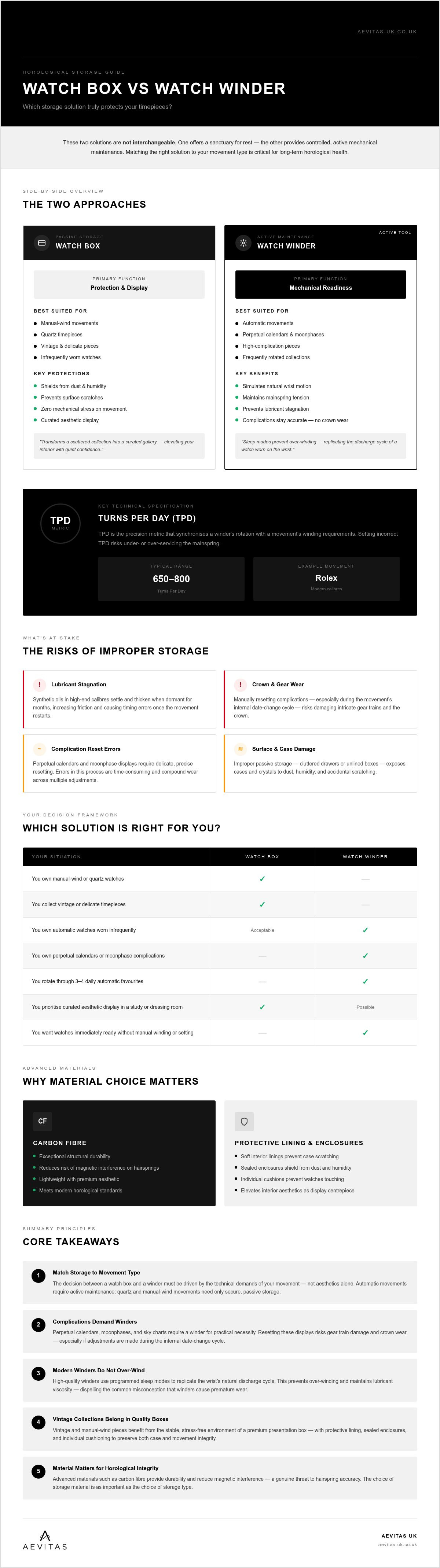
Watch Box vs Watch Winder: A Comparison for Your Collection
Deciding between a watch box vs watch winder requires a balance between mechanical necessity and aesthetic preference. The choice often rests on whether you view your timepieces as objects for active use or passive preservation. Keeping a watch active maintains lubricant viscosity; resting a watch can preserve the integrity of vintage seals and gaskets. Your decision should align with your specific collector profile.
| Feature | Watch Presentation Box | Automatic Watch Winder |
|---|---|---|
| Maintenance | Passive protection from dust. | Active mechanical movement. |
| Security | Scratch-resistant soft linings. | Anti-magnetic carbon fibre or safes. |
| Display | Static, curated gallery. | Kinetic, 360-degree presentation. |
| Investment | Lower cost per watch slot. | Premium investment for utility. |
Most collectors fall into one of three categories. The Purist prioritises original condition, often opting for boxes to keep vintage movements dormant. The Tech-Enthusiast values the engineering of modern complications and requires a winder to keep perpetual calendars synchronised. The Daily Wearer seeks the convenience of a hybrid approach, using a winder for frequent pieces and a box for occasional ones.
Choosing Based on Watch Type
The "Winder Rule" is simple: if the watch has complex complications that are difficult to reset, it belongs in a winder. When your collection grows, a multi-watch winder becomes significantly more space-efficient than managing several individual boxes. Conversely, the "Box Rule" applies to manual-wind pieces, high-frequency quartz, and vintage watches with delicate internal components. These timepieces benefit from the stable, non-rotational environment of a premium presentation case.
Space and Aesthetic Considerations
Organisation is a transition from disorder to refinement. A large collection of individual boxes can quickly clutter a nightstand or dressing room. A single multi-watch unit provides a streamlined solution that complements a modern interior. Noise is a critical factor for bedside storage. Silent operation is the hallmark of a luxury winder. We utilise high-performance motors specifically designed to operate without vibration or sound, ensuring your collection is maintained without disturbing your environment.
Whether you require the active utility of a winder or the elegant display of a box, our collection offers the precision your timepieces demand. Explore our range of premium winders to find the perfect match for your horological assets.
Elevating Your Storage Strategy with Aevitas UK
Aevitas UK represents the intersection of British design excellence and global horological standards. As the UK's best-selling premium brand in this niche, we understand that storage is an extension of the timepiece itself. Our 2026 collection of Carbon Fibre Watch Winders showcases this commitment to modern engineering. These units provide a high-performance environment that guards against magnetism whilst maintaining a sleek, durable aesthetic. Whether you're finalising your watch box vs watch winder decision or looking to expand an existing setup, our philosophy remains centred on precision and protection. We act as a knowledgeable guide, ensuring that your transition from disorder to refinement is both seamless and sophisticated.
The Hybrid Solution: Winder Safes
For collectors of high-value assets such as Rolex, Patek Philippe, or Audemars Piguet, the choice between a watch box vs watch winder is often superseded by the need for absolute security. A Watch Winder Safe provides the ultimate hybrid solution for the modern collector. It combines the active mechanical maintenance of a multi-watch winder with the ironclad protection of an insurance-approved safe. These units are constructed from fireproof and drill-resistant materials, ensuring your most prized calibres are shielded from both mechanical stagnation and external threats. Choosing a winder safe is the gold standard for those who refuse to compromise. It offers the calm and control that comes with knowing your investment is maintained to horological standards whilst being physically impenetrable.
Why Aevitas UK is the Collector’s Choice
We pride ourselves on being a trusted advisor for the modern gentleman, providing solutions that balance luxury with practical utility. Our commitment to excellence includes free insured delivery worldwide, ensuring that high-value orders arrive in pristine condition. For those beginning their journey into refined storage or looking for a secondary unit, our clearance sale offers access to premium entry-level options without sacrificing our rigorous standards. We provide a steady, purposeful path from the clutter of a nightstand to a professional, organised gallery. By choosing Aevitas, you're investing in a storage strategy that respects the emotional and financial value of your collection. It's a heritage-focused approach that values tradition alongside modern engineering, ensuring your timepieces remain in peak condition for generations to come.
Securing the Future of Your Horological Collection
The decision between a watch box vs watch winder is a defining moment for any serious collector. It marks the transition from simple ownership to professional curation. You've seen that the choice depends on the specific technical demands of your calibres. Whether you require the active rotation needed for a perpetual calendar or the stable sanctuary of a velvet-lined presentation case, your storage solution must match the standard of the timepiece itself. It's about maintaining mechanical health whilst elevating your home interior with a sense of quiet confidence.
As the UK's best-selling premium watch winder brand, Aevitas UK provides the precision engineering required for Rolex, Patek Philippe, and Omega timepieces. Our 2026 collection ensures your complications stay synchronised and your finishes remain pristine. We take the worry out of logistics by offering free insured worldwide delivery on every order. You can trust that your investment is being maintained to the highest horological standards. Take the next step in refining your storage strategy and ensure your collection remains ready for the wrist at a moment's notice.
Explore the Aevitas UK Collection of Luxury Winders and Boxes and discover the perfect environment for your treasures.
Frequently Asked Questions
Do watch winders damage automatic watches over time?
High-quality watch winders do not damage automatic watches when programmed correctly. Modern units incorporate intermittent rotation and sleep cycles to prevent over-winding the mainspring. This simulates natural wrist movement whilst ensuring the internal lubricants maintain their viscosity. Using a winder helps avoid the mechanical "gumming up" that occurs during long periods of inactivity. It is essential to choose a model with adjustable settings to match your specific movement’s requirements and manufacturer standards.
Can I put a manual-wind watch in a watch winder?
You should never place a manual-wind watch in a watch winder. These devices are designed specifically for automatic movements that utilise a rotor to tension the mainspring. A manual-wind watch lacks this rotor; therefore, rotation provides no benefit and may place unnecessary stress on the internal winding mechanism. For these timepieces, a luxury presentation box or a watch stand is the appropriate storage solution, offering protection without redundant mechanical motion or risk to the calibre.
How many turns per day (TPD) does my watch need?
Most modern luxury watches require between 650 and 900 TPD to remain fully wound. For instance, many Rolex movements are optimised at 650 TPD with bidirectional rotation, whilst certain Patek Philippe calibres may require 800 TPD. It is vital to consult your watch manufacturer’s specifications or use a movement database. Aevitas winders allow you to precisely adjust these settings, ensuring your timepiece receives exactly the energy it needs without excessive wear or mechanical strain.
Is it better to let an automatic watch stop or keep it running?
Keeping an automatic watch running is generally better for the movement’s long-term health, especially for pieces with complex complications. Constant motion prevents the synthetic oils from settling or thickening, which can lead to increased friction. In the watch box vs watch winder debate, a winder is the superior choice for watches you wear frequently or those with perpetual calendars that are time-consuming to reset once the power reserve has depleted and the movement stops.
What is the best material for a luxury watch box?
The best materials for a luxury watch box combine structural durability with internal softness. Solid hardwoods or modern carbon fibre provide a robust exterior shell that protects against impact. Internally, look for linings made from high-grade velvet or microsuede. These non-abrasive fabrics prevent micro-scratches on polished cases and bracelets. Ensure the cushions are adjustable to accommodate different wrist sizes, maintaining the watch's shape without stretching the strap or bracelet whilst keeping it securely positioned.
Are watch winders noisy to keep on a bedside table?
Premium watch winders are designed to operate in near-total silence, making them perfectly suitable for bedside tables. Aevitas utilises high-performance, Japanese-engineered motors that eliminate the vibration and mechanical hum associated with lower-quality alternatives. This silent operation ensures your collection remains wound and ready without disrupting your sleep. If you are sensitive to noise, look for units with shielded motor housings and precision-balanced rotors that maintain a steady, quiet rhythm during their active rotation cycles.
Should I buy a watch winder safe for my collection?
Investing in a watch winder safe is highly recommended for collections of high financial or sentimental value. These units offer an insurance-approved environment that combines active movement with physical security. Most safes feature fireproof construction and drill-resistant steel plating, protecting your assets from theft and environmental disasters. It is the gold standard for serious collectors who want the convenience of a multi-watch winder alongside the peace of mind provided by a secure, heavy-duty vault.
Does a watch box protect against magnetism?
A standard watch box provides physical protection but minimal defence against magnetism unless specifically engineered with shielded materials. In the context of a watch box vs watch winder, certain carbon fibre models offer better resistance to magnetic interference than traditional wooden boxes. Magnetism can cause a watch’s hairspring to stick, leading to significant timing errors. For maximum protection, store your collection away from large speakers, tablets, or magnetic clasps, or utilise a professionally shielded watch winder safe.
0 comments