

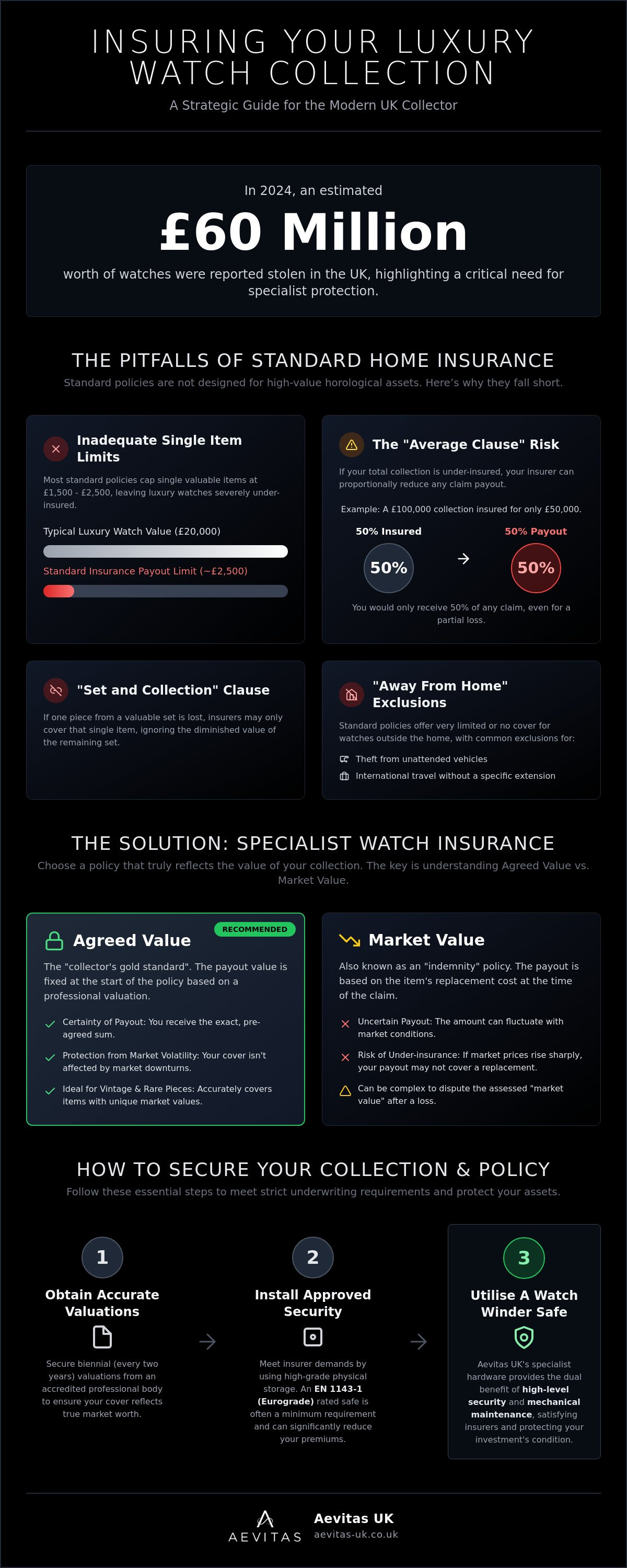
With approximately £60 million worth of watches reported stolen in the UK in 2024, the security of your horological investment has never been more precarious. This alarming figure highlights why insuring a luxury watch collection UK is no longer a simple administrative task. It's a strategic necessity for the modern collector. You've likely spent years curating your pieces, yet the volatility of the secondary market and the complexity of insurer requirements often create more anxiety than protection.
We understand that you seek refinement and order for your collection. This guide provides the expert clarity required to manage specialist insurance options, accurate biennial valuations, and the rigorous security standards that insurers now demand. You'll learn how to secure "Agreed Value" policies that reflect true market worth and how the right physical storage can significantly lower your premiums. We'll examine the shift toward EN 1143-1 graded safes and the essential steps to ensure your assets remain protected at home and whilst travelling abroad.
Key Takeaways
- Identify the limitations of standard home contents policies and why "single item limits" often leave high-value horological assets under-insured.
- Master the distinction between Agreed Value and Market Value to ensure your payout reflects the true worth of your collection in a fluctuating market.
- Learn the essential criteria for insuring a luxury watch collection UK, including the necessity of biennial valuations from accredited professional bodies.
- Understand Eurograde security standards and how selecting the correct insurance-approved safe can meet strict underwriting requirements whilst reducing premiums.
- Discover how specialist hardware, such as watch winder safes, provides the dual benefit of high-level protection and mechanical maintenance for your investment.
Why Standard Home Insurance Often Fails UK Watch Collectors
Relying on a standard home insurance policy to protect a high-value horological portfolio is a common, yet costly, oversight. Standard UK contents insurance is designed for general household goods, not the rapidly appreciating assets found in a serious collection. For those considering the specifics of insuring a luxury watch collection UK, the first hurdle is the "Single Item Limit". Most off-the-shelf policies cap payouts for individual valuables at between £1,500 and £2,500. For a modern Rolex or Patek Philippe, this limit covers only a fraction of the replacement cost. In the 2026 UK insurance market, the Single Item Limit represents the maximum financial liability an insurer will accept for any one undeclared object, typically plateauing at £2,500 for standard premiums.
Beyond the cap on individual pieces, the "Average Clause" presents a significant financial risk. If an insurer determines you have under-insured your total collection, they may apply a proportional reduction to any claim. If you insure a £100,000 collection for £50,000, the insurer might only pay 50% of a partial loss. Similarly, the "Set and Collection" clause can be devastating. If a single piece from a matched set is lost, many standard insurers will only pay for the individual item's value, ignoring the significant depreciation caused to the remaining pieces. When your assets exceed a total value of £10,000, specialist insurance becomes a functional necessity.
The Problem with General Contents Coverage
Generalist insurers often lack the technical expertise to appreciate the nuances of horology. Proving the value of a vintage piece after a theft is notoriously difficult without a specialist valuation. Throughout the history of watches, these items have transitioned from simple tools to complex investments. Standard policies frequently exclude "High Risk" items from accidental damage cover. This leaves you vulnerable to everyday mishaps that a specialist policy would typically encompass. If an insurer flags your home as high-risk due to your collection's value, installing a watch winder safe can often bridge the gap between a rejection and a successful policy application.
Understanding "Away from Home" Exclusions
Security concerns extend beyond the front door. Many standard UK policies offer restricted cover once an item leaves the domestic residence. "Away from home" clauses often require specific "All Risks" extensions for pieces worn in public or taken abroad. Collectors frequently fall foul of "unattended vehicle" exclusions. Standard insurers rarely pay out if a watch is stolen from a car, regardless of whether it was locked or hidden. A specialist policy provides the confidence that your pieces are protected whilst on your wrist, whether you are in London or travelling internationally. It's a strategic necessity for the modern collector.
Choosing Specialist Watch Insurance: Agreed Value vs Market Value
Selecting the right policy structure is the most critical step in insuring a luxury watch collection UK. Whilst standard policies often rely on vague "market rates", bespoke coverage offers a choice between Agreed Value and Market Value. For a serious collector, the distinction is far from academic. An Agreed Value policy locks in a specific payout amount based on a professional appraisal at the start of the term. This provides absolute certainty; if a timepiece is lost or stolen, you receive the exact sum listed on your schedule, regardless of market fluctuations. Conversely, Market Value (or Indemnity) policies pay out based on the replacement cost at the time of the loss. This can be problematic for vintage pieces where prices are volatile or for contemporary models that experience sudden spikes in demand.
When searching for a provider, always prioritise FCA-regulated brokers who specialise in high-net-worth assets. These experts understand the nuances of horological investments and can navigate complex underwriting requirements. Specialist watch insurance often includes "New for Old" cover for modern collections, ensuring you receive a brand-new equivalent rather than a depreciated cash settlement. This is particularly vital for contemporary pieces that are still in production but may have seen significant retail price hikes since their original purchase.
Agreed Value: The Collector’s Gold Standard
Locking in a price provides a vital buffer against market corrections. Consider the 2025 price adjustments; for instance, the Rolex Daytona in Yellow Gold saw a 14% increase, rising from £36,100 to £41,200. An Agreed Value policy ensures your coverage keeps pace with these shifts without requiring a mid-term adjustment. It is the preferred choice for brands like Patek Philippe or Audemars Piguet, where secondary market premiums often dwarf original retail prices. To maintain this protection, you should store your pieces in a watch winder safe to ensure they remain in the pristine, appraisal-ready condition required by specialist insurers.
Key Clauses to Look For in a UK Policy
A sophisticated policy should include inflation protection, which automatically increases your sum insured by a set percentage, often 10%, to account for annual market growth. You should also look for a "Pairs and Sets" clause. This ensures that if one item of a matched set is lost, the insurer covers the loss in value for the remaining piece. Finally, the "Right of First Refusal" is a hallmark of premium cover. It allows you to buy back a stolen timepiece from the insurer if it is eventually recovered by the police, preserving the heritage and continuity of your collection.
The Valuation Process: Ensuring Your Collection is Accurately Covered
Securing an accurate appraisal is the cornerstone of insuring a luxury watch collection UK. Without a professional document, you're essentially guessing your financial exposure. In the UK, the Institute of Registered Valuers (IRV) serves as the premier authority for these assessments. Their members are trained to identify the subtle nuances that dictate value, from the condition of a movement to the presence of original tritium dials. An IRV-certified valuation carries significant legal weight in UK insurance claims, providing a robust, undisputed figure that underwriters must respect.
Understanding the difference between valuation types is essential. A "Retail Replacement" valuation focuses on the cost of purchasing an equivalent item new at current prices. This is standard for modern pieces. However, "Fair Market" valuations are more appropriate for rare or vintage timepieces where a direct replacement isn't possible. When insuring a luxury watch collection UK, the valuation frequency is just as important as the initial appraisal. Given that luxury watch prices are notoriously volatile, we recommend revaluing your collection every two to three years. This frequency ensures your coverage remains aligned with current market trends, preventing the risks of under-insurance often found in standard home insurance policies.
Finding a Qualified UK Valuer
General high street jewellers often lack the technical expertise to value high-complication pieces or rare references. You require a specialist who understands the nuances of the secondary market and recent auction results. A qualified valuer will provide a detailed report including high-resolution photographs and verified serial numbers. This level of detail is non-negotiable for high-value claims; it leaves no room for ambiguity regarding the item's condition or authenticity.
Maintaining an Audit Trail
Effective protection requires a rigorous digital and physical audit trail. Store high-resolution scans of original receipts, warranty cards, and certificates of authenticity. Organising your assets with luxury storage protects the physical condition of your timepieces and provides a central location for their "box and papers". Additionally, register your pieces with the "Watch Register". This database documents stolen assets, making it harder for thieves to sell your pieces whilst increasing recovery chances.
Meeting Insurer Security Requirements: Safes and Storage Standards
High-value insurance is a contract of mutual responsibility. When you are insuring a luxury watch collection UK, the policy schedule will almost certainly mandate specific physical security measures. These requirements are not mere suggestions; they are warranties. Failure to comply with the stipulated storage conditions can result in a voided claim during a loss. Underwriters typically look for safes that meet the European Standard EN 1143-1, commonly referred to as the Eurograde rating. This certification ensures the safe has undergone rigorous testing against professional attack methods.
The correlation between safe ratings and insurance limits is precise. Insurers determine the maximum value of jewellery they will cover by multiplying the safe's cash rating by ten. For example, a safe with a £6,000 cash rating (Grade 0) provides coverage for up to £60,000 worth of watches. If your collection's value exceeds this, a Grade 1 safe with a £10,000 cash rating is required to protect assets up to £100,000. For portfolios exceeding these amounts, insurers may mandate higher Eurograde levels or even a "Cash Rating" of £10,000 or more as a baseline requirement for the policy to remain valid.
Eurograde Ratings Explained for Collectors
Selecting the correct grade is the first step toward compliance. Grade 0 and Grade 1 are the most common benchmarks for private collectors. Beyond theft protection, fire resistance is a vital secondary consideration for protecting original warranty cards and certificates of authenticity. Whilst large, visible safes act as a deterrent, many specialist UK underwriters prefer "hidden" installations. These are discreetly integrated into cabinetry or floorboards to reduce the risk of a targeted "drag" attack. Regardless of the grade, professional bolting to a solid concrete floor or brick wall is a non-negotiable requirement for meeting UK insurance criteria.
The Risk of Leaving Watches on Display
The aesthetic appeal of a high-complication timepiece often tempts owners to keep them on open display stands. This creates a significant insurance vulnerability. Most UK policies include exclusions for "theft without forcible entry". If a watch is stolen whilst left on a bedside table or an unsecured stand, the insurer may argue that you failed to take "reasonable care". This negligence clause is a common trap that invalidates claims for even the most prestigious collections.
Maintaining a balance between enjoying your collection and securing it requires intelligent hardware. You can secure your collection with insurance-approved safes that feature integrated winders, keeping your movements healthy whilst remaining under lock and key. It is also vital to distinguish between a safe's manufacturer warranty and your home insurance. A safe warranty only covers the hardware's mechanical integrity; it does not provide financial compensation for the stolen contents themselves.
Securing Your Assets with Aevitas UK Storage Solutions
Aevitas UK provides the sophisticated hardware required to meet the stringent demands of insuring a luxury watch collection UK. Whilst traditional safes offer protection, they often neglect the mechanical needs of automatic timepieces. Aevitas UK Watch Winder Safes resolve this by merging high-level security with precision horological care. These units ensure your pieces remain wound and ready for wear whilst housed within a secure, steel-reinforced environment. It's a solution designed for the discerning collector who values both the financial security of their assets and the operational health of their movements.
Our products are designed specifically for the British market, adhering to the high standards expected by local collectors and insurers alike. By centralising your collection within a secure, managed environment, you create a sense of order that reflects the value of the items themselves. This methodical approach to storage is the final step in achieving complete peace of mind for your horological investments.
Insurance-Approved Watch Winder Safes
The architecture of an Aevitas UK safe is built on durability and accessibility. Constructed with heavy-duty steel and secured with advanced digital locks, these safes provide the physical barrier necessary to satisfy UK underwriters. Internal motion-sensing lighting allows for effortless selection, whilst the pre-set TPD (Turns Per Day) settings accommodate the specific winding requirements of all major luxury brands. This level of customisation prevents over-winding and reduces unnecessary wear on the internal components. For those seeking the pinnacle of material excellence, you might find The Ultimate Guide to Carbon Fibre Watch Winders for Luxury Collections useful for understanding how modern materials enhance storage.
Organising for Security and Longevity
From an insurance perspective, organisation is a proxy for care. Storing high-value assets in a generic drawer or an unsecured box is often viewed as negligence by UK insurers. A dedicated winder safe demonstrates a commitment to "reasonable care", a term frequently used in specialist policies. Beyond the safe, the transition from storage to the wrist requires equal attention. Using luxury watch rolls for secure transport ensures your pieces are protected from scratches and impact whilst away from the safe. This reduces the risk of accidental damage, which is a common cause for claims that can lead to increased premiums.
Maintaining your collection in a secure, organised fashion ensures that every piece remains in appraisal-ready condition. It simplifies the biennial valuation process mentioned earlier and provides a clear audit trail for insurers. Explore the Aevitas UK range of premium watch winders and safes to find the ideal storage solution for your growing portfolio.
Protecting Your Horological Legacy
Effective protection requires a synergy between specialist "Agreed Value" policies and rigorous physical storage. You've identified how standard contents insurance leaves significant financial gaps. By prioritising biennial valuations and meeting Eurograde security standards, you ensure your portfolio remains resilient against market volatility and theft. This transition from vulnerability to total refinement is a hallmark of the sophisticated collector.
As a premier British brand specialising in luxury watch accessories, Aevitas UK provides the engineering required to satisfy strict underwriting criteria. Our insurance-approved hardware is compatible with all major luxury watch brands, ensuring movement longevity whilst under lock and key. You can invest in an insurance-approved watch winder safe from Aevitas UK and benefit from free insured delivery worldwide. Securing your assets doesn't need to be complex. With a strategic approach to insuring a luxury watch collection UK, you can enjoy your timepieces with absolute confidence and calm.
Frequently Asked Questions
Do I need to list every watch on my UK insurance policy?
You must individually list any timepiece that exceeds your policy’s "unspecified item" threshold. Standard UK policies often require items valued over £1,500 to be declared as specified assets to ensure they are fully protected. Failing to disclose high-value pieces can lead to a claim being capped at the single item limit or rejected entirely due to non-disclosure.
What is the "Single Item Limit" on a standard UK home insurance policy?
The Single Item Limit is the maximum financial compensation an insurer provides for any one undeclared item, typically ranging from £1,500 to £2,500. If your watch’s replacement cost exceeds this figure, it isn't fully covered under general contents. You'll need to specify the item on your schedule and pay a tailored premium to reflect its true market value.
How does an insurance-approved safe lower my premiums in the UK?
Installing a Eurograde-rated safe reduces the underwriter’s risk, which often results in lower annual premiums. Insurers reward collectors who invest in high-level physical security as it demonstrates "reasonable care" in protecting the assets. When insuring a luxury watch collection UK, using an approved safe can be the difference between a standard premium and a significant high-risk surcharge.
Will my luxury watch be covered if I travel abroad?
Coverage whilst travelling depends on whether your policy includes "Personal Possessions" or "All Risks" extensions for use outside the home. Specialist policies usually offer worldwide protection for 30 to 60 days per year. You should verify specific exclusions, such as theft from unattended vehicles or hotel rooms, which are common pitfalls in standard UK travel insurance clauses.
What is the difference between Agreed Value and Market Value for watches?
Agreed Value provides a fixed payout based on a pre-approved appraisal, whilst Market Value pays the replacement cost at the time of the claim. Agreed Value is the preferred choice for rare or vintage pieces as it offers financial certainty. Market Value policies can leave you vulnerable if the secondary market prices spike suddenly before you've updated your policy.
Do I need a professional valuation to insure my watch collection?
A professional valuation from an IRV-certified expert is a mandatory requirement for most specialist insurers. This document provides the necessary evidence of authenticity, condition, and current replacement value. Without a recent valuation, typically conducted within the last three years, insuring a luxury watch collection UK becomes difficult as underwriters lack a verified baseline for the sum insured.
What happens if my watch increases in value after I take out the policy?
You must notify your insurer of any significant appreciation to ensure your sum insured remains accurate. Whilst some premium policies include an automatic "inflation guard," this may not cover the sharp double-digit increases seen in the luxury market. Regular re-valuations every two years are essential to prevent the risk of under-insurance and proportional payout reductions.
Are watch winders safe to use for long-term storage of insured pieces?
Watch winders are an excellent solution for long-term storage as they prevent the movement’s lubricants from congealing. Using a winder safe satisfies both the mechanical needs of the timepiece and the security requirements of your insurer. This proactive care ensures your watches remain in the pristine condition required for future insurance appraisals whilst staying protected within a graded enclosure.
0 comments