

You reach for your favourite timepiece on a Monday morning, only to find the hands frozen and the date window lagging three days behind. It is a recurring frustration for many collectors. Resetting intricate complications like moon phases or perpetual calendars is a tedious task that disrupts your routine. Beyond the effort of manual resets, many enthusiasts worry about how to keep an automatic watch wound to prevent internal lubricants from settling or drying out.
Maintaining a consistent power reserve is essential for both convenience and the long-term health of your movement. This guide will show you how to master the art of watch maintenance through expert techniques and premium winding solutions. We will explore the mechanics of modern movements, the role of manual winding, and how to select a silent, precision-engineered winder to ensure your collection remains refined, organised, and always ready to wear.
Key Takeaways
- Understand the kinetic relationship between your natural movement and the mainspring to maintain a consistent power reserve.
- Master the professional techniques on how to keep automatic watch wound through a balance of daily wear and strategic manual intervention.
- Protect intricate complications by learning to avoid the mechanical 'danger zone' when resetting date and moon phase functions.
- Identify the technical specifications required for premium winding solutions, including customisable Turns Per Day (TPD) and directional control.
- Ensure the longevity of your collection by using non-abrasive storage and automated winding to keep internal lubricants properly distributed.
The Mechanics of Motion: How Automatic Watches Stay Wound
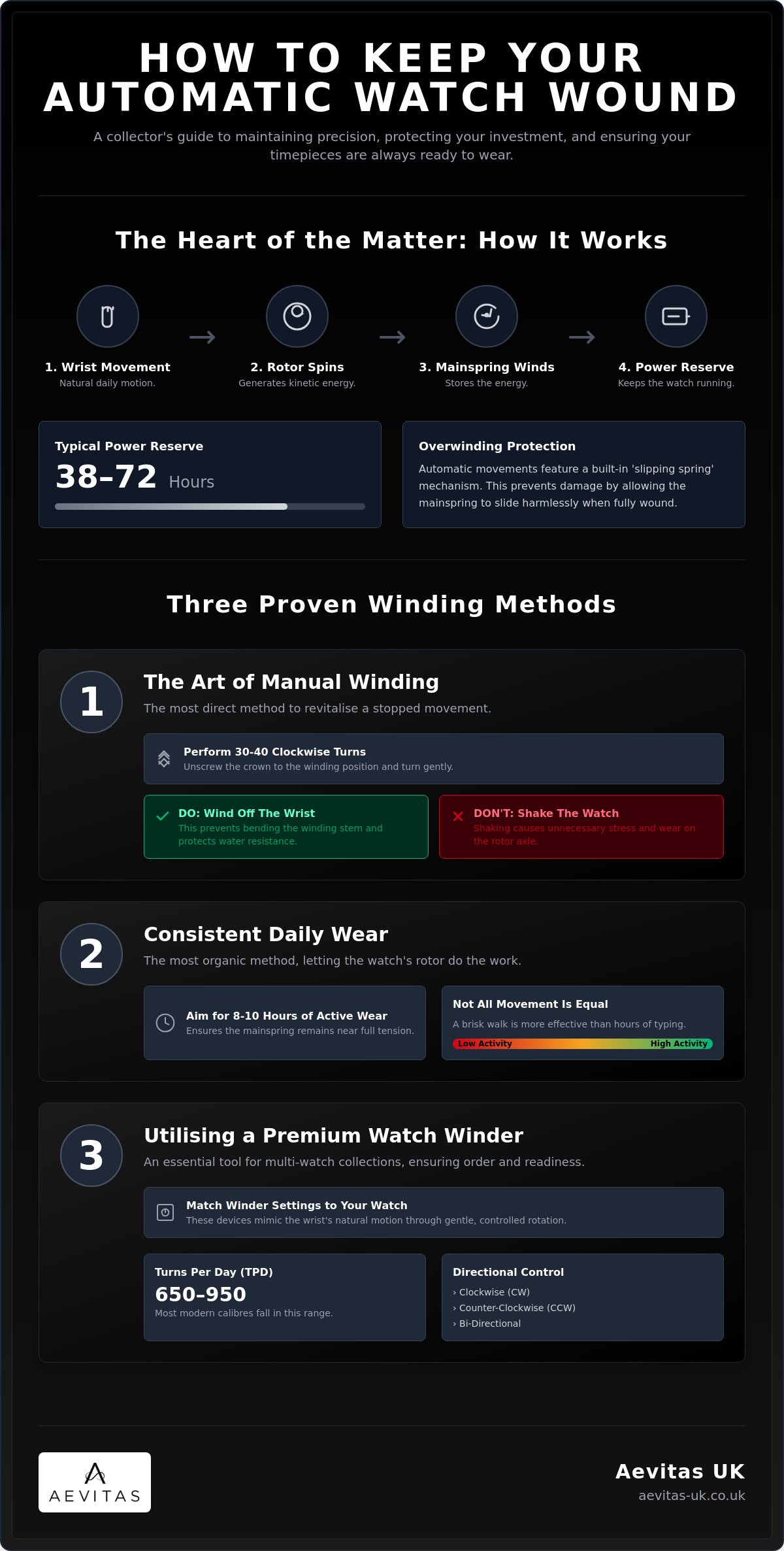
An Automatic watch is a masterpiece of mechanical efficiency. Unlike its manual counterparts, it relies on the wearer's physical activity to remain functional. This process is governed by a weighted rotor, a semi-circular component that pivots freely within the movement. As you move your arm, gravity pulls the rotor, causing it to spin. This rotation generates kinetic energy which is then channelled through a series of gears to the mainspring. It is a seamless transition from biological motion to mechanical power.
The Role of the Rotor and Mainspring
The rotor acts as a miniature pendulum, reacting to every gesture, from a morning stroll to a firm handshake. This energy is coiled into the mainspring, which serves as the heart of the mechanical movement. A power reserve is defined as the total duration a watch will continue to run whilst stationary. Most modern luxury timepieces offer a reserve of 38 to 72 hours, though this depends entirely on the tension held within the mainspring. When the watch is off the wrist, this stored tension slowly releases to drive the escapement and hands.
New collectors often worry about damaging their investment through excessive motion. However, automatic movements feature a 'slipping spring' or bridle mechanism. When the mainspring is fully wound, the end simply slides along the inside of the barrel rather than snapping. This ensures you never have to worry about how to keep automatic watch wound too tightly, as the mechanism is designed to protect itself from over-tension. Understanding this safety feature provides peace of mind when using automated winding solutions.
Why Natural Motion Isn't Always Enough
Despite the efficiency of the rotor, sedentary lifestyles often fail to provide the necessary torque. Desk-bound professionals who spend hours typing may find their watches lose time or stop prematurely. The rotor requires sufficient arc and frequency to keep the mainspring under tension. If you are rotating a large collection, most of your watches will inevitably deplete their power reserve within two to three days of being placed in a presentation box.
This creates a cycle of disorder where date complications and moon phases must be manually corrected before every wear. Precision requires consistency. If your daily activity levels are low, mastering how to keep automatic watch wound involves more than just passive wear. It requires a structured approach to maintenance that ensures your timepieces are always ready for use, preserving both the mechanical integrity of the movement and the refinement of your daily routine.
This dedication to maintaining complex systems is also found in high-level professional training; for those looking to refine their leadership, you can explore TA EMCC Senior Team Coach Academy to develop expertise in team dynamics and organisational change.
Three Proven Methods to Keep Your Watch Wound
Maintaining the momentum of a mechanical movement is a task that requires both precision and a structured routine. It isn't merely about ensuring the hands continue to move. It is about preserving the delicate calibration of your timepiece. When considering how to keep automatic watch wound, you must choose a method that suits your lifestyle whilst respecting the mechanical limits of the calibre. Whether you are a daily wearer or a weekend enthusiast, these three strategies provide the necessary tension to keep your collection in peak condition.
1. The Art of Manual Winding
Manual winding is the most direct way to revitalise a stopped movement. Many novices mistakenly believe that shaking a watch is a valid way to initiate the rotor. This is poor advice. Shaking causes unnecessary stress on the rotor axle and can lead to premature wear. Instead, unscrew the crown to the winding position. Turn it clockwise approximately 30 to 40 times. You will likely hear a subtle click or feel a slight increase in resistance as the mechanism engages the mainspring. Always perform this task off your wrist. Winding whilst wearing the watch can bend the winding stem, leading to costly repairs and a loss of water resistance.
2. Consistent Daily Wear
The most organic approach is to let the watch do the work. To reach a full charge, aim for 8 to 10 hours of active wear. It is important to remember that not all movement is equal. A brisk walk or a commute is far more effective at spinning the rotor than several hours spent typing at a desk. If you have a growing collection, organise your rotation to ensure each piece receives adequate wrist time. This prevents the internal lubricants from pooling and ensures the power reserve remains topped up. Consistency is the hallmark of a disciplined collector.
3. Utilising a Premium Watch Winder
For those with multi-watch collections, a winder is an essential tool for refinement and order. These devices mimic the natural motion of the wrist through gentle, controlled rotation. To use one effectively, you must set the Turns Per Day (TPD) to match your specific movement's requirements. Most modern calibres require between 650 and 950 TPD. You must also select the correct direction: clockwise, counter-clockwise, or bi-directional. Placing your dormant pieces in multi watch winders ensures they are ready to wear at a moment's notice, eliminating the frustration of resetting complex date complications. This controlled environment is the ultimate solution for how to keep automatic watch wound without the need for daily intervention.
The Collector's Dilemma: To Wind or Not to Wind?
The debate amongst horologists often centres on a single, pivotal question. Does constant motion accelerate mechanical wear, or does it preserve the movement's integrity? For the discerning collector, the answer is rarely a simple binary. It requires a nuanced understanding of modern horological engineering. Whilst some purists argue that a stationary watch is a safe watch, others recognise that mechanical systems are designed to be exercised. Deciding how to keep automatic watch wound depends largely on how frequently you intend to wear each specific piece in your collection.
The Myth of Mechanical Wear
Modern calibres are robust. They are engineered for decades of continuous operation. Metal-on-metal wear within a high-grade movement is negligible, provided the watch is serviced every 5 to 7 years. During a professional service, components are cleaned and fresh lubricants are applied to ensure friction remains at a minimum. If you adhere to this maintenance schedule, the wear caused by a winder is statistically insignificant.
There is a hidden risk in leaving a watch dormant. Frequent manual resetting of time and date complications puts repeated stress on the crown, winding stem, and delicate rubber gaskets. These components are often the first to fail. Over time, the repeated act of pulling the crown to its furthest position can compromise water resistance. In many cases, the mechanical strain of daily manual adjustment exceeds the gentle, consistent rotation of a precision winder.
Preventing Lubricant Stagnation
Think of a high-performance car engine. It performs best when it is run regularly. The same logic applies to a mechanical watch. Motion keeps oils distributed evenly across the escapement and gear train. Modern synthetic oils are highly resistant to drying or gumming compared to the animal-based lubricants used in vintage pieces. However, they are not immune to the laws of physics. If a watch sits stationary for months, these oils can migrate away from the critical friction points they are meant to protect.
A watch that runs occasionally is less likely to suffer from 'sticky' components or erratic timekeeping. When lubricants pool or 'set' in one area, the initial friction required to restart the movement can be higher than normal. This puts unnecessary torque on the gear train. Maintaining a steady state of motion ensures that the movement remains 'limber' and ready for immediate service.
Aevitas UK recommends a balanced approach to collection management. For your primary rotation, a winder offers the ultimate in refinement and convenience. It ensures your favourite pieces are always synchronised and lubricated. For timepieces that only see the light of day once or twice a year, a luxury presentation box or a watch roll provides the necessary protection for long-term rest. Mastering how to keep automatic watch wound is about choosing the right tool for the right frequency of wear, ensuring order and longevity for your entire investment.
Managing Complex Complications and Large Collections
For the enthusiast with a single three-hand timepiece, a depleted power reserve is a minor inconvenience. For the serious collector possessing perpetual calendars or moon phase complications, it is a significant logistical hurdle. These intricate calibres are designed to track time across months and years. When they stop, the synchronisation process is both time-consuming and mechanically delicate. Learning how to keep automatic watch wound through automated solutions isn't just about convenience. It's about protecting the movement from the risks associated with manual correction.
One of the most overlooked risks is the horological 'danger zone'. Between 9 PM and 3 AM, the gears responsible for the date change are fully engaged. Attempting to manually advance the date or moon phase during these hours can snap gear teeth or bend levers. This is a common cause of expensive repairs. By using a winder, you maintain the movement's natural progression. This eliminates the need to intervene during these critical hours, ensuring the calendar functions remain perfectly aligned without human error.
The Necessity of Constant Power for Calendars
Perpetual calendars are marvels of engineering that account for leap years and varying month lengths. If allowed to stop, resetting them often requires a complex series of pusher adjustments or dozens of crown rotations. Moon phase displays are equally demanding. Aligning the lunar cycle precisely with the current phase can take considerable effort. A dedicated winder ensures these 'smart' features remain accurate. It allows you to transition from one watch to another without a secondary setup phase, preserving the refinement of your daily routine.
Organising Multi-Watch Winding Stations
As your gallery grows, a single winder is no longer sufficient. Multi-watch winding stations provide a centralised hub for your collection. These units allow for individual TPD and directional settings for each watch. A Rolex might require a different rotation pattern than a Patek Philippe. High-quality stations utilise carbon fibre or premium leather finishes to match the luxury of the timepieces they house.
Aevitas UK designs these systems for silent operation. They are discreet enough for a bedside table or a refined dressing room. To manage your growing collection with precision, explore our range of multi watch winders to find a solution that offers both protection and order. It is the definitive answer to how to keep automatic watch wound whilst maintaining the aesthetic standards of a high-end collection. By centralising your maintenance, you transform a cluttered drawer into a curated display of horological excellence.
Professional Solutions for Winding and Protection
Mastering the technical requirements of your collection is only half the battle. The final step in refinement is selecting the hardware that provides both momentum and security. When you consider how to keep automatic watch wound, the equipment you choose must match the calibre of the timepieces it services. A substandard winder can be noisy, unreliable, or even abrasive to polished steel and precious metals. Precision requires a controlled environment where rotation is managed with mathematical accuracy.
Choosing the Right Watch Winder
The heart of any premium winder is its motor. You should prioritise Japanese motors, which are renowned for their near-silent performance and long-term durability. A loud motor is a sign of poor engineering and can be a distraction in a study or bedroom. Beyond the mechanics, the aesthetic should reflect your personal style. Aevitas UK carbon fibre winders offer a contemporary, high-tech finish that complements modern sports watches and chronographs.
Functionality must also account for the physical dimensions of your collection. Always verify that the winder cushions are compatible with your specific wrist circumference. A cushion that is too large can stretch a leather strap or put undue tension on a metal bracelet. Conversely, a loose fit allows the watch to rattle, potentially scratching the case back. A customisable fit ensures the watch remains centred and secure throughout every rotation cycle.
- Select units with independent TPD (Turns Per Day) settings for each rotor.
- Ensure the winder has a 'rest' phase to prevent the slipping spring from constant activity.
- Look for non-magnetic shielding to protect the hairspring from interference.
Secure Storage and Safes
For high-value collections in the United Kingdom, security is a primary concern for insurance compliance. A standard display box offers organisation but lacks the protection required for significant investments. Insurance-approved safes with integrated multi-watch winders provide the ultimate solution. These units offer fire protection and theft deterrence whilst ensuring your most valuable pieces are always ready for the wrist. It is the transition from simple storage to a professional-grade horological gallery.
If you are frequently on the move, a luxury watch roll provides a portable solution. Whilst rolls do not actively wind the watch, they protect the exterior finish from scratches and impact during transit. For the pieces remaining at home, a dedicated winding station remains the most effective way to manage your power reserves. To find the perfect balance of security and mechanical maintenance, explore the Aevitas UK collection of premium watch winders and safes to elevate your collection. Investing in professional-grade solutions is the only definitive answer to how to keep automatic watch wound whilst maintaining the long-term value of your horological assets.
Refining Your Horological Routine
Mastering how to keep automatic watch wound is a hallmark of the refined collector. It transforms a simple hobby into a disciplined pursuit of horological excellence. By balancing natural motion with precision-engineered automation, you protect your movement's delicate complications and ensure essential lubricants remain perfectly distributed. Your timepieces are more than just tools. They're significant investments that deserve the highest standard of care, order, and protection.
As the UK's best-selling premium winder brand, Aevitas UK provides solutions compatible with all luxury marques, including Rolex, Omega, and Patek Philippe. Our range prioritises silent operation and non-abrasive materials to safeguard your collection's finish. Whether you require a carbon fibre single winder or an insurance-approved safe, our products provide the reliability you expect. Discover Britain's finest range of luxury watch winders and storage at Aevitas UK and enjoy free insured delivery worldwide. Take the next step in refining your routine. Ensure every piece in your gallery is always ready for the moment it's called upon.
Frequently Asked Questions
Can I overwind my automatic watch by hand?
No, you cannot overwind a modern automatic watch. These movements use a slipping spring or safety bridle that allows the mainspring to slide inside the barrel once it reaches full tension. This prevents the spring from snapping under pressure. Whilst the mechanism is robust, you should still wind the crown with a gentle, consistent motion to avoid unnecessary stress on the winding pinion or stem.
Is it bad to let an automatic watch stop?
Letting a watch stop occasionally isn't harmful, but prolonged dormancy can lead to issues. Modern synthetic oils are engineered to resist drying, but they can still migrate away from critical friction points if the movement remains stationary for months. Keeping the watch active ensures these lubricants stay evenly distributed across the gear train. This maintains the accuracy and longevity of the calibre over several years.
How many turns per day (TPD) does my watch need?
Most modern automatic movements require between 650 and 950 turns per day to maintain their power reserve. This figure varies significantly by manufacturer. For instance, many Rolex calibres are designed for 650 TPD, whilst certain Valjoux chronographs might require 800 or more. You should always consult your specific movement's technical data to ensure your winder is programmed for the most efficient and least taxing rotation.
Do watch winders damage the movement over time?
High-quality winders won't damage your movement if they are configured with the correct settings. Damage is usually the result of using cheap, unshielded winders that lack a rest phase or subject the watch to magnetic interference. A precision winder mimics the natural, gentle motion of the wrist. It provides a controlled environment and is a safe, reliable method for how to keep automatic watch wound without causing fatigue.
Should I wind my watch clockwise or counter-clockwise?
This depends entirely on the specific calibre inside your timepiece. Some watches wind in both directions, known as bi-directional, whilst others only wind in one direction, either clockwise or counter-clockwise. If you set a uni-directional watch to rotate in the wrong direction, the rotor will spin freely without storing any energy. Most collectors use a bi-directional setting if the manufacturer's specification is not immediately available.
Can I leave my watch on a winder 24/7?
You can leave your watch on a winder indefinitely, provided the device isn't constantly spinning. Professional winders include a rest or sleep cycle that pauses rotation for several hours. This prevents the slipping spring from being in a constant state of activity, which would cause unnecessary wear. A properly programmed winder replicates a realistic wearing schedule. It keeps the watch ready for use whilst protecting the mechanical integrity of the mainspring.
What is the 'danger zone' when setting a mechanical watch?
The 'danger zone' is the period between 9 PM and 3 AM when the date-change mechanism is engaged. During these hours, the gears responsible for advancing the calendar are physically linked to the movement's drive train. Manually adjusting the date or time during this window can shear gear teeth or bend delicate levers. You should always advance the hands past 3 AM before making any manual calendar or moon phase adjustments.
How do I know if my watch is fully wound?
You won't feel a definitive stop when winding an automatic watch because of the safety bridle mechanism. Usually, 30 to 40 full rotations of the crown are sufficient to reach a full charge. If you are unsure how to keep automatic watch wound to its peak, check for a power reserve indicator on the dial. Without this feature, 10 hours of active wear or a completed winder cycle will ensure the mainspring is fully tensioned.
0 comments