

Is your luxury timepiece merely resting on your bedside table, or is its intricate movement slowly seizing whilst it sits idle? For many British collectors, the choice between a watch winder vs watch box isn't just about aesthetics; it's a critical decision regarding mechanical longevity. You've spent years curating a collection that reflects your personal success, so the anxiety of seeing a movement dry out or a perpetual calendar fall out of sync is entirely justified. A disorganised dresser isn't just a clutter problem. It's a risk to the precision engineering you value.
We understand that protecting your investment requires more than just a lid and a cushion. This guide clarifies the functional differences between automated rotation and static storage to help you select the perfect sanctuary for your watches. You'll gain a clear understanding of which device best preserves your specific movements whilst creating an elegant, organised display. We will explore technical rotation settings, the benefits of dust-free presentation, and how to establish a maintenance strategy that provides total confidence in your collection's future.
Key Takeaways
- Identify the critical distinction between active mechanical maintenance and passive protection to ensure your luxury timepieces remain in peak condition.
- Learn why complex complications, such as perpetual calendars, almost always require the consistent rotation provided by a high-quality winder.
- Resolve the watch winder vs watch box dilemma by evaluating your daily rotation habits against the specific technical needs of your movement.
- Understand the importance of customisable Turns Per Day (TPD) settings in preventing mechanical strain and over-winding.
- Discover how premium British craftsmanship and materials like carbon fibre provide a sophisticated, durable sanctuary for a growing collection.
The Collector’s Dilemma: Choosing Between a Watch Winder and a Watch Box
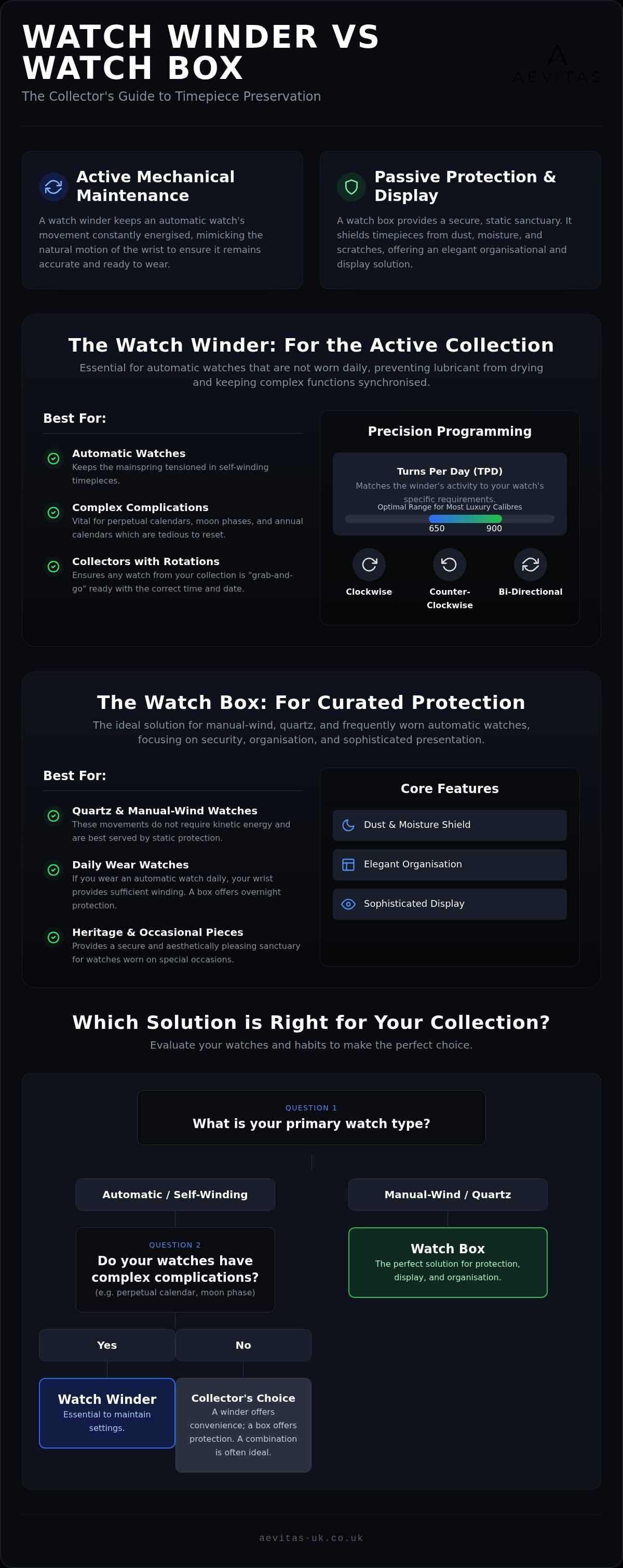
For the discerning collector, storage is never an afterthought. It's a technical necessity. Leaving a high-value piece in a standard bedside drawer or on a cluttered desk exposes it to scratches, dust, and micro-vibrations that can degrade the finish over time. Worse, it lacks the organisational refinement your collection deserves. The decision in the watch winder vs watch box debate depends on whether you require active mechanical maintenance or purely passive protection. Both serve as a sanctuary, yet they perform fundamentally different roles in your horological ecosystem.

Your daily routine dictates your storage strategy. A collector with a three-watch rotation needs different tools than a curator of twenty vintage pieces. If you find yourself resetting the time and date every Monday morning, you're experiencing the primary pain point a winder resolves. Conversely, if you value the ritual of winding a watch by hand or own a collection of battery-powered pieces, the static elegance of a presentation box is unmatched. Storage is not just about organisation; it's a technical extension of the watch movement itself.
When Protection is the Priority
A luxury watch box serves as a static sanctuary. It's the ideal solution for quartz movements or manual-wind pieces that don't rely on kinetic energy to stay powered. These presentation cases shield your investment from moisture and airborne particulates whilst offering a sophisticated display for your dressing room. If your collection consists of heritage pieces worn only on special occasions, a box provides the security and aesthetic order you need without the necessity of mechanical intervention. It transforms a scattered group of timepieces into a curated gallery, protecting the external craftsmanship of the case and strap.
The Need for Constant Motion
Automatic watches are living machines. They rely on a weighted rotor to tension the mainspring, a process central to the automatic watch mechanism. When left stationary for extended periods, the lubricants within the movement can migrate or dry out, potentially leading to sluggish performance or costly service requirements. A premium watch winder ensures your timepiece is always "grab-and-go" ready, maintaining the correct time and date even through weeks of non-wear. This is particularly vital for watches with complex complications like moon phases or perpetual calendars, which are notoriously tedious to reset. Essentially, a watch winder acts as a mechanical surrogate for the human wrist.
Choosing between a watch winder vs watch box is ultimately a question of mechanical necessity versus display preference. A well-rounded collection often requires a blend of both to ensure every piece is preserved according to its specific engineering.
Understanding the Mechanism: How an Automatic Watch Winder Functions
An automatic watch is a masterpiece of kinetic energy. Within the movement, a mainspring stores the power required to drive the hands and complications. On the wrist, a weighted rotor spins with every gesture, keeping this spring tensioned. Once removed, the power reserve begins its countdown. A winder replicates this natural movement, ensuring the mainspring remains energised through controlled rotation. This mechanical support is the defining factor in the watch winder vs watch box debate; one maintains the internal life of the piece, whilst the other merely houses its exterior.
Precision is paramount. Not all movements are identical. Most luxury calibres require between 650 and 900 Turns Per Day (TPD) to maintain optimal torque. Programmable settings allow you to match the winder's activity to your watch's specific requirements. Directional settings are equally critical. Some movements only wind clockwise, others counter-clockwise, and many require bi-directional rotation. Using an incorrect setting won't damage the watch, but it will fail to keep it wound. Understanding these nuances is essential when deciding between a watch winder vs watch box for your specific collection.
Precision Programming for Luxury Brands
Sophisticated collectors understand that a "one size fits all" approach is insufficient for high-complication pieces. Different calibres exert different levels of resistance on the mainspring. Premium winders feature intermittent rotation cycles and "sleep modes" that mimic natural human behaviour. This ensures the watch isn't under constant tension for 24 hours straight, allowing the mechanism to rest. For a deeper technical exploration, you can read our guide on how to keep an automatic watch wound.
Silent Performance and Engineering
The hallmark of a superior winder is near-total silence. Low-quality alternatives often utilise unshielded motors that produce an audible hum and, more dangerously, magnetic interference. Magnetism is the enemy of horological accuracy; it can cause the hairspring to stick, leading the watch to run fast. Professional-grade premium watch winders utilise shielded Japanese motors to eliminate this risk. This engineering ensures your collection remains protected from both mechanical stagnation and external electrical forces.
Selecting the right equipment requires a balance between mechanical necessity and aesthetic preference. Whilst a winder represents a higher initial investment, the cost-to-benefit ratio is often justified by the reduced need for professional servicing. Continuous motion keeps internal lubricants from pooling or coagulating, ensuring the delicate gears remain coated in a protective film. In contrast, a watch box offers a more traditional approach, prioritising the physical security of the case and crystal without the complexity of electronic components. Choosing between a watch winder vs watch box often comes down to the scale of your collection and your mechanical priorities.
Considerations regarding space also play a vital role in this decision. A single winder is a discreet addition to a nightstand, but a growing collection may eventually require multi watch winders housed in a dedicated cabinet. This provides a dynamic, rotating showcase that highlights the craftsmanship of each piece. For those who prefer a static gallery, a glass-top presentation box allows for immediate visual access to a dozen or more timepieces at once. This creates a refined focal point in a dressing room whilst keeping every item organised in one central location.
The Pros and Cons of Active Winding
The primary advantage of active winding is the preservation of time and accuracy. For watches featuring perpetual calendars or moon phase complications, the process of manual resetting is notoriously time-consuming. A winder removes this burden entirely, keeping the piece ready for immediate wear. However, owners must account for a power source. Most premium models require a mains connection for consistent performance, though battery-operated versions offer flexibility for placement inside a safe. This makes them indispensable for the high-complication collector who values convenience alongside mechanical health.
The Benefits of Premium Watch Boxes
Collectors who value simplicity and scale often find a premium watch box to be the definitive choice. These cases have no mechanical parts to maintain, making them a reliable, lifetime storage solution. They act as a central hub, allowing you to organise a large variety of pieces in one elegant centre. We often suggest that luxury watch storage boxes are ideal for heirloom pieces or manual-wind watches that do not require constant rotation. This approach ensures your most sentimental items remain dust-free and impeccably presented, resolving the watch winder vs watch box debate through pure organisational elegance.
Assessing Your Collection: Which Storage Solution Suits Your Lifestyle?
Your daily habits are the ultimate arbiter in the watch winder vs watch box debate. If you're a "one-watch man" who wears a single automatic timepiece daily, a simple presentation box or a luxury stand is often sufficient. However, for the frequent rotator who enjoys matching a different watch to their attire, the "Complexity Rule" applies. Watches featuring annual calendars, moon phases, or perpetual calendars are mechanically demanding to reset. If these pieces stop, you're looking at several minutes of tedious adjustment before you can leave the house. In this scenario, a winder isn't just a luxury; it's a productivity tool for the busy professional.
Budgeting for your accessories should be as methodical as the purchase of the watch itself. We recommend allocating approximately 5% to 10% of a timepiece's market value toward its storage sanctuary. A £10,000 investment deserves more than a generic drawer. Many sophisticated British collectors now adopt a hybrid approach. They utilise multi watch winders for their active rotation and high-complication pieces, whilst using a premium watch presentation box for their manual-wind heirlooms and quartz chronographs. This strategy balances mechanical health with organised elegance.
Tailoring Storage to Your Brand
Different luxury brands have distinct mechanical appetites. Rolex enthusiasts, for instance, must be mindful of specific TPD requirements to ensure the Perpetual movement remains fully energised without unnecessary stress. Conversely, Omega owners with Co-Axial escapements may find their movements slightly more resilient, yet they still benefit from the consistent lubrication a winder provides. If you're unsure how your specific calibre reacts to stationary storage, consult our brand-specific FAQs to find the optimal settings for your collection.
Security and Insurance Considerations
In the United Kingdom, insurance requirements for high-value collections are becoming increasingly stringent. A standard watch box offers no protection against theft, and leaving multiple high-value pieces on a dressing table may even invalidate your home insurance policy. For collections exceeding a certain valuation, an insurance-approved watch winder safe is the only logical solution. These units provide the mechanical benefits of a winder whilst meeting the security standards required by premium insurers. For more information on securing your investment, refer to our watch winder safe installation guide to ensure your sanctuary is as impenetrable as it is precise.
Elevating Your Storage: Why Premium British Craftsmanship Matters
Aevitas UK operates at the intersection of heritage design and modern engineering. We believe that storage is an extension of the timepiece itself. Selecting between a watch winder vs watch box involves more than just choosing a container; it's about investing in a system that mirrors the precision of your watch. Our philosophy prioritises materials that offer both aesthetic refinement and mechanical longevity. A premium winder isn't merely a convenience. It's a safeguard for your asset, ensuring that the movement remains as fluid as the day it left the manufacturer.
One often overlooked detail is the cushion. Generic storage often uses rigid, oversized pillows that can stretch leather straps or strain metal bracelets. Our bespoke cushions are engineered to accommodate various wrist sizes, providing a secure fit without exerting pressure on the clasp. This attention to detail ensures that the physical integrity of your watch is protected whilst the winder maintains its internal health. By choosing a high-standard device, you're effectively reducing the long-term cost of ownership by preventing preventable mechanical wear. The transition from a cluttered drawer to a dedicated Aevitas sanctuary offers a sense of calm and control over your investment.
The Carbon Fibre Advantage
Carbon fibre represents the pinnacle of modern material science in watch accessories. It is incredibly lightweight yet possesses high-strength properties that surpass traditional wood or leather. This material perfectly complements the "sport-luxury" aesthetic of modern chronographs and diver watches. Beyond looks, carbon fibre is resistant to temperature fluctuations and moisture, providing a stable environment for your collection. It doesn't warp or degrade over time, making it the superior choice for durability. For a comprehensive look at this material, read The Ultimate Guide to Carbon Fibre Watch Winders.
The Aevitas UK Service Promise
We understand the emotional and financial value of your collection. That's why every order includes free insured delivery across the UK and worldwide, ensuring your purchase arrives in pristine condition. Whether you're seeking the ultimate mechanical upgrade from our collection of premium watch winders or you require an elegant sanctuary for your non-automatic pieces amongst our watch boxes, we provide the expertise to guide your choice. Resolving the watch winder vs watch box dilemma requires a partner who values your timepieces as much as you do. Our British-designed solutions offer the perfect blend of luxury and practical utility for the discerning collector.
Securing the Future of Your Horological Investment
Selecting the right sanctuary for your collection is a commitment to mechanical excellence. The watch winder vs watch box decision ultimately rests on the specific needs of your movements and your personal rotation habits. Whilst a presentation box offers refined organisation for your manual-wind and quartz pieces, a programmable winder is the only way to ensure your automatic complications remain ready for immediate wear. By prioritising technical precision and high-grade materials, you eliminate the risks of lubricant stagnation and accidental damage.
Aevitas UK is the UK’s best-selling premium watch winder brand, offering British-designed solutions compatible with Rolex, Omega, and all major luxury houses. Every order includes free insured worldwide delivery to ensure your investment arrives in pristine condition. It's time to transition from simple storage to a sophisticated gallery that reflects the value of your timepieces. Explore the Aevitas UK Collection of Premium Watch Winders and Boxes to find the perfect guardian for your collection today. Your timepieces deserve a sanctuary that matches their precision.
Frequently Asked Questions
Is a watch winder better than a watch box for an automatic watch?
A winder is superior for active maintenance, whilst a box is better for passive protection. Winders prevent lubricants from coagulating and keep complications like moon phases accurate. A box is ideal if you prefer the ritual of manual winding or own quartz pieces. In the watch winder vs watch box debate, your choice depends on whether you value mechanical readiness or simple, static organisation.
Can a watch winder damage my automatic watch movement?
High-quality winders with programmable settings cannot damage your watch. Modern automatic movements feature a slipping clutch mechanism to prevent over-winding. However, unshielded motors in cheap alternatives can cause magnetic interference, which may affect accuracy. Choosing a premium, shielded model ensures your movement remains safe from electrical forces whilst staying perfectly tensioned for your next wear.
How long can an automatic watch sit without being wound?
Most automatic watches will stop after 38 to 48 hours of inactivity. Whilst sitting idle for a few days isn't harmful, leaving a watch stationary for months can cause internal lubricants to migrate or dry out. This stagnation eventually leads to increased friction and the need for more frequent professional servicing. Consistent rotation is the best way to preserve the movement's long-term health.
Do I need a watch winder for a Rolex or Omega?
Whilst not strictly mandatory, a winder is highly recommended for Rolex and Omega pieces to maintain their chronometric precision. These brands utilise sophisticated calibres that benefit from consistent movement to keep lubricants distributed. A winder ensures your Rolex Perpetual or Omega Co-Axial is always ready for wear. It removes the need for manual time-setting and reduces wear on the winding crown.
What is the benefit of a carbon fibre watch winder?
Carbon fibre offers exceptional durability and a modern, high-tech aesthetic that complements luxury sport watches. It is lightweight, resistant to temperature changes, and provides a stable environment for your timepieces. This material ensures your winder remains a long-lasting sanctuary that won't warp or degrade over years of use. It represents the perfect fusion of contemporary style and robust engineering for the discerning collector.
Are watch winders noisy to keep on a bedside table?
Premium winders are engineered for near-silent operation using high-quality Japanese motors. Unlike budget alternatives that produce a distracting hum, professional-grade models are virtually inaudible during their rotation cycles. This makes them perfectly suitable for placement on a bedside table or in a quiet study. You can enjoy the visual appeal of your rotating collection without any disruption to your sleep or concentration.
Can I store a quartz watch in a watch winder?
You can store a quartz watch in a winder, but it won't benefit from the rotation. Quartz movements are battery-powered and don't require kinetic energy to stay wound. In the watch winder vs watch box comparison, a static watch box is generally the more practical and cost-effective choice for quartz collections. Use your winder slots for automatic pieces that actually require the mechanical motion.
How many turns per day (TPD) does my watch require?
Most luxury automatic watches require between 650 and 900 TPD to remain fully energised. The specific requirement depends on your watch's calibre and manufacturer specifications. Using a programmable winder allows you to set the exact TPD and direction to match your watch's needs. This precision prevents mechanical strain and ensures the mainspring remains at an optimal level of tension without over-winding the movement.
0 comments